

Secondary Highway Accidents Prove Deadly in South Korea
Translated from Korean, summarized and contextualized by DistantNews.
At a glance
News
Sources not specified
Context piece
- Secondary accidents on South Korean highways are highly lethal, with a fatality rate 37 times higher than overall traffic accidents.
- Drivers often fail to move their vehicles to safety after a minor collision, leading to fatal outcomes.
- Experts recommend a "Move Over Law" similar to the U.S. system, requiring drivers to slow down or change lanes when approaching stopped emergency or disabled vehicles.
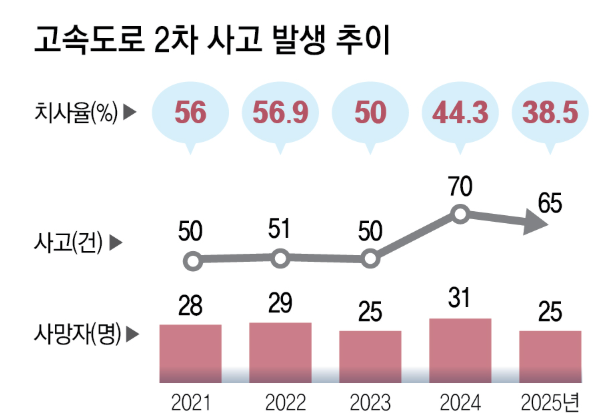
Secondary accidents on South Korean highways pose a severe threat, carrying a fatality rate 48.3%, which is 37 times higher than the average for all traffic accidents. This alarming statistic highlights the extreme danger faced by individuals involved in initial collisions, particularly when they remain in active traffic lanes.
Drivers often fail to move their vehicles to safety after a minor collision, leading to fatal outcomes.
A common and dangerous practice observed is drivers failing to move their vehicles to the safety of the shoulder after a minor accident. Instead, they often remain in the road to assess damage, contact insurance, or film the scene. This delay, even for a minute, can be catastrophic. In one instance, a driver who exited his truck after a collision was struck and killed by another vehicle less than a minute later. Another recent incident involved a car driver killed after stopping on the highway following a collision.
The fatality rate was 48.3%, 37 times higher than the average for all traffic accidents.
Authorities promote the "Beatbox" safety guideline: turn on hazard lights, open the trunk, move outside the guardrail, and then call for help. However, drivers frequently neglect these steps due to panic or a perceived need to preserve the accident scene. Highway patrol officers emphasize that staying near a damaged vehicle on a high-speed road is life-threatening, urging drivers to prioritize personal safety above all else.
Drivers often fail to move their vehicles to safety after a minor collision, leading to fatal outcomes.
To combat this deadly issue, experts suggest implementing a "Move Over Law," similar to systems in the United States. This law would mandate that drivers slow down and, if possible, change lanes when approaching emergency vehicles or disabled vehicles stopped on the highway. While South Korea has general rules for safe driving and yielding to emergency vehicles, specific regulations requiring drivers to slow down or move over for accident scenes are lacking. Implementing such measures, alongside enhanced public awareness of safety protocols like "Beatbox," is seen as crucial to reducing fatalities on the nation's highways.
The fatality rate was 48.3%, 37 times higher than the average for all traffic accidents.
DistantNews Editorial
Originally published by Dong-A Ilbo in Korean. Translated, summarized, and contextualized by our editorial team with added local perspective. Read our editorial standards.
More Stories

From Our Blog

What Gets Lost (and Found) When News Is Translated

The Critical Role of Diaspora Media in Global News

What Travellers Should Know About Countries with Restricted Press

A Digital Nomad's Guide to Following Local News

How the Same Story Looks Different in Different Countries
