

Sheinbaum celebrates lower insecurity perception in Mexico, credits security results
Translated from Spanish, summarized and contextualized by DistantNews.
At a glance
News
Named sources
Context piece
- President Claudia Sheinbaum celebrated a decrease in the perception of insecurity in Mexico, citing progress in the government's security strategy.
- Data from Inegi's National Urban Security Public Survey shows that 59.8% of adults in 91 urban areas felt insecure in June 2026, a decrease from previous periods.
- Sheinbaum noted that while perception lags behind crime statistics like homicide rates, the trend reflects public recognition of security improvements.
Mexican President Claudia Sheinbaum Pardo highlighted a recent decline in the perception of insecurity across the country, attributing the trend to the positive outcomes of her administration's security strategy. She pointed to data from the National Urban Security Public Survey (ENSU), conducted by the National Institute of Statistics and Geography (Inegi), which indicated a notable shift in public sentiment.
The population is beginning to notice the advances in security.
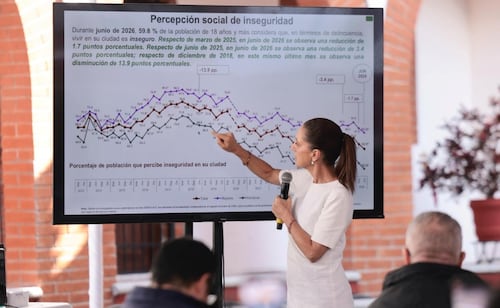
According to the Inegi report, in June 2026, 59.8% of individuals aged 18 and over residing in 91 urban areas considered living in their city to be insecure. While this figure remains above 50%, Sheinbaum emphasized that it represents a significant decrease compared to previous periods. She acknowledged that public perception of security often reacts more slowly than objective indicators, such as homicide rates, but stressed that the current trend suggests the public is beginning to notice the government's efforts.
During her morning press conference in Cuernavaca, Morelos, Sheinbaum presented a graph illustrating the evolution of the ENSU data. She noted that at the beginning of former President Andrés Manuel López Obrador's term in December 2018, 73.7% of the population in major cities felt insecure. This percentage had fallen to 58.6% by the end of his administration in September 2024. Sheinbaum's own administration saw an initial increase in insecurity perception, reaching 63.8% in December 2025, but it has since resumed a downward trajectory, reaching the current 59.8% in June 2026.
Perception sometimes lags because it depends on many things.
"Perception sometimes lags because it depends on many things," Sheinbaum explained, adding that public perception is influenced by daily news about criminal events, arrest reports, and personal experiences. However, she reiterated her confidence that the downward trend in insecurity perception aligns with the reported progress in public security matters under her leadership. The President asserted that the results demonstrate that the population "is beginning to notice" the advances being made.
The important thing here is that we are delivering results on security indicators and people are beginning to notice that decrease.
DistantNews Editorial
Originally published by El Universal in Spanish. Translated, summarized, and contextualized by our editorial team with added local perspective. Read our editorial standards.
More Stories


From Our Blog

What Press Freedom Means for the News You Read

What Gets Lost (and Found) When News Is Translated

The Critical Role of Diaspora Media in Global News

What Travellers Should Know About Countries with Restricted Press

A Digital Nomad's Guide to Following Local News
