


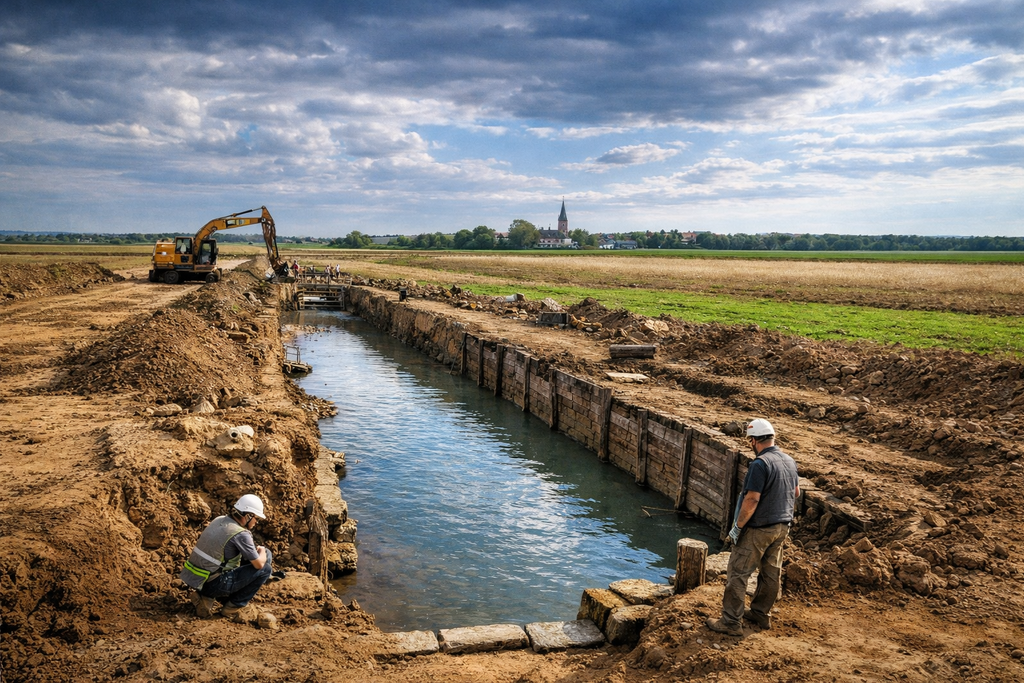
Shocking Discovery: 2,000-Year-Old Roman "Superhighway" Found Under German Fields
Translated from Greek, summarized and contextualized by DistantNews.
TLDR
- Archaeologists in central Germany have discovered a remarkably preserved 2,000-year-old Roman canal, measuring approximately 15 meters wide and 2.5 meters deep.
- This artificial waterway, built between the 1st and 4th centuries AD, served as a vital "superhighway" for small riverboats transporting goods, materials, and troops, connecting the Rhine River to a Roman fort.
- The discovery challenges previous assumptions about Roman transportation in northern Europe, demonstrating their advanced engineering capabilities in reshaping landscapes for strategic and commercial purposes, and suggests continued use into the 8th century.
A groundbreaking discovery in the heart of Germany has unearthed a testament to Roman ingenuity: a 2,000-year-old artificial canal, a veritable "superhighway" of its time. Hidden beneath unassuming fields in the Hessische Ried region, this meticulously engineered waterway, approximately 15 meters wide and 2.5 meters deep, has rewritten our understanding of Roman infrastructure north of the Alps.
For centuries, historians believed the Romans primarily relied on natural river systems for transport in their northern provinces. However, this find, dating between the 1st and 4th centuries AD, proves otherwise. It reveals the Romans' sophisticated capability to not only navigate but also to fundamentally reshape entire landscapes for strategic and commercial advantage. The canal likely served as a crucial link between the Rhine River and a Roman fort in Trebur-Astheim, facilitating the movement of goods, building materials, and even troops.
What makes this discovery particularly astonishing is its apparent longevity and continued use well into the early Middle Ages, possibly until the 8th century AD. Evidence suggests that the Merovingian and early Carolingian rulers maintained the canal, potentially even integrating it into the infrastructure supporting the royal palace at Trebur. This challenges the notion of a complete abandonment of Roman infrastructure after the empire's decline, highlighting a more nuanced continuity of engineering and societal organization.
From a German perspective, this discovery is more than just an archaeological marvel; it's a tangible connection to a sophisticated past that directly influenced the development of our region. It underscores the advanced technical skills of Roman engineers and their far-reaching impact, demonstrating that their influence extended beyond military conquest to encompass ambitious civil engineering projects that shaped the very land we inhabit today. This "underground Roman highway" offers a unique glimpse into a period of history that continues to resonate.
DistantNews Editorial
Originally published by Ta Nea in Greek. Translated, summarized, and contextualized by our editorial team with added local perspective. Read our editorial standards.
More Stories


From Our Blog

What Gets Lost (and Found) When News Is Translated

The Critical Role of Diaspora Media in Global News

What Travellers Should Know About Countries with Restricted Press

A Digital Nomad's Guide to Following Local News

How the Same Story Looks Different in Different Countries
