


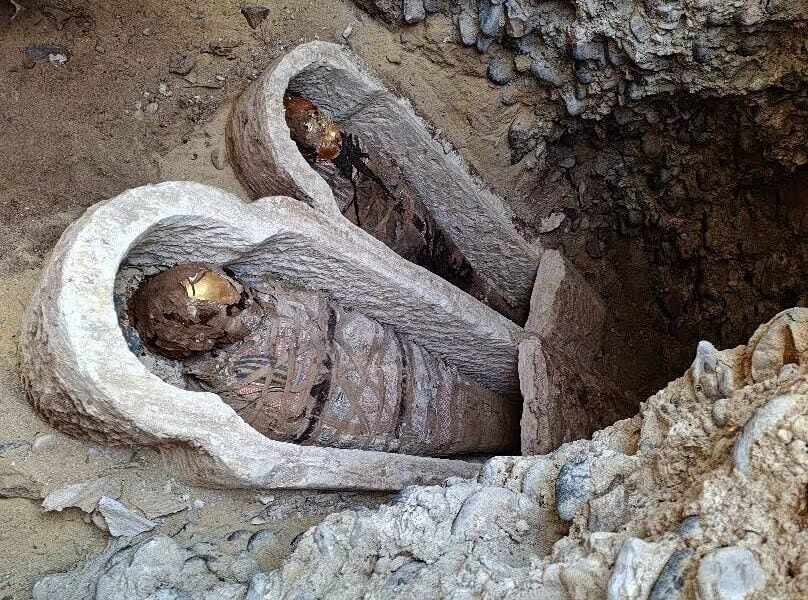
Shocking Discovery: Mummy in Egypt Linked to the Iliad - What Was Found
Translated from Greek, summarized and contextualized by DistantNews.
TLDR
- An archaeological discovery in Al-Bahnasa, ancient Oxyrhynchus, Egypt, revealed a mummy containing a papyrus fragment from Homer's Iliad.
- The find, made by a Spanish-Egyptian mission, is from a Roman-era necropolis and includes other artifacts like painted sarcophagi and gold leaf.
- The papyrus, featuring lines from the 'Catalogue of Ships,' highlights the spread of Greek education and cultural fusion in Hellenistic and Roman Egypt.
This remarkable discovery at Al-Bahnasa, the ancient Oxyrhynchus, offers a profound glimpse into the deep cultural intermingling that characterized Hellenistic and Roman Egypt. The presence of a papyrus fragment from Homer's Iliad, specifically the 'Catalogue of Ships,' within a mummy is not merely an archaeological curiosity; it speaks volumes about the enduring legacy of Greek literature and its integration into local customs and beliefs.
The text includes verses from the second rhapsody of the Iliad, specifically the famous 'Catalogue of Ships,' which lists the Greek forces that participated in the campaign against Troy.
For Greek and Egyptian scholars, this find reinforces Oxyrhynchus's reputation as a vital center of literacy and culture. The fact that a text as foundational to Greek identity as the Iliad was not only present but also incorporated into funerary practices suggests a society where Greek education was widespread and deeply respected. This challenges any simplistic view of Egypt solely through a Pharaonic lens, revealing a complex tapestry woven with threads from Greece and Rome.
Ta Nea, as a Greek publication, views this discovery with particular pride. It underscores the far-reaching influence of ancient Greek civilization and its ability to resonate across cultures and millennia. While Western media might focus on the archaeological significance or the Egyptian context, for us, it's a powerful testament to the Hellenic world's cultural diaspora and its lasting impact. The papyrus serves as a tangible link, connecting modern Greece to its ancient past and to the broader Mediterranean heritage.
The presence of such a literary text in a funerary context in Egypt suggests not only the spread of Greek education but also the deep cultural osmosis that characterized the region during the Hellenistic and Roman periods.
This find is more than just a historical artifact; it's a symbol of cultural osmosis. It demonstrates how Greek texts and ideas permeated daily life, religious practices, and even the afterlife beliefs of people in Roman Egypt. The inclusion of the Iliad in a burial context could symbolize aspirations for heroism, remembrance, or a journey akin to that of the epic heroes, reflecting a shared cultural understanding that transcended geographical boundaries.
The discovery adds a new dimension to the understanding of burial customs of the period, highlighting the coexistence of Egyptian and Greek elements in a unified cultural whole.
DistantNews Editorial
Originally published by Ta Nea in Greek. Translated, summarized, and contextualized by our editorial team with added local perspective. Read our editorial standards.
More Stories



From Our Blog

What Gets Lost (and Found) When News Is Translated

The Critical Role of Diaspora Media in Global News

What Travellers Should Know About Countries with Restricted Press

A Digital Nomad's Guide to Following Local News

How the Same Story Looks Different in Different Countries
