


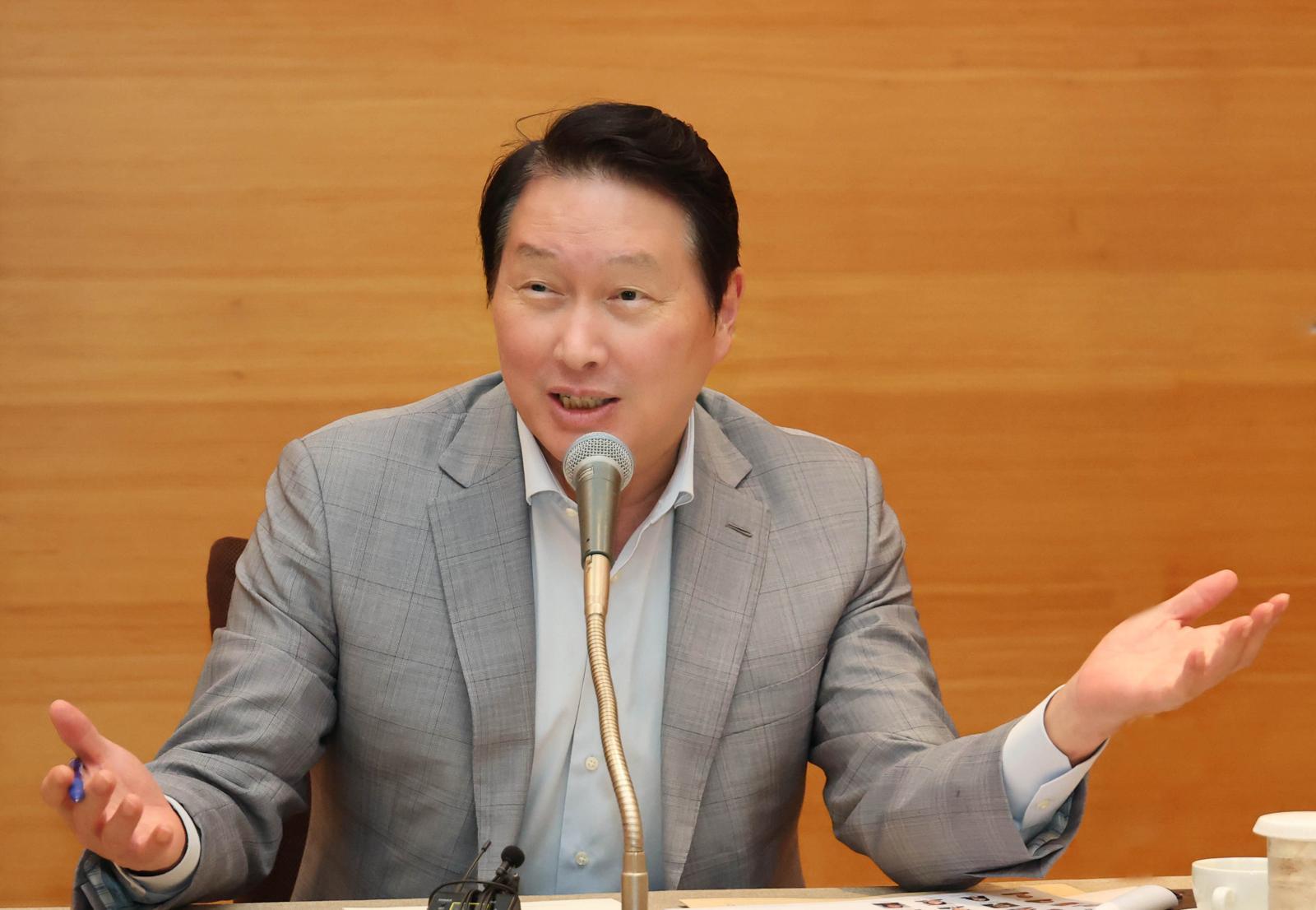
SK Chairman Links Employee Happiness to Stakeholder Well-being Amid Bonus Row
Translated from Korean, summarized and contextualized by DistantNews.
At a glance
News
Sources not specified
Context piece
- SK Group Chairman Chey Tae-won addressed the controversy surrounding performance bonuses at SK Hynix.
- He stated that stakeholder happiness, including shareholders, must accompany employee happiness for sustainable growth.
- Chey also discussed potential US expansion for SK Hynix and the semiconductor market's supply-demand imbalance.
SK Group Chairman Chey Tae-won addressed the recent controversy over performance bonuses at affiliate SK Hynix, stating that while employee happiness is a goal, it must be shared with stakeholders, including shareholders, for sustainable growth. "The premise is that stakeholders must be happy together," Chey said during a press conference at the 49th JeJu Forum of the Korea Chamber of Commerce and Industry.
The premise is that stakeholders must be happy together.
Chey indicated that adjustments might be necessary if the bonus system infringes upon the interests of shareholders and other stakeholders. He also confirmed that SK Hynix is considering building semiconductor plants in the United States, a move that comes amid pressure from U.S. Commerce Secretary Gina Raimondo for increased domestic chip production. "We are considering it and are in the process of finding a location," Chey stated, emphasizing the strategic importance of U.S. investment.
Regarding the semiconductor market, Chey described the current supply-demand imbalance as "chaos." He projected that demand for memory chips will increase significantly next year, with minimal corresponding supply growth. "Demand next year will increase by at least 60 to 100% compared to now, and there is almost no increase in supply," he explained, noting intense lobbying from customers and governments worldwide for memory chip procurement due to economic security concerns.
We are considering it and are in the process of finding a location.
Chey also refuted claims of government coercion in selecting the site for the Gwangju-Jeonnam semiconductor cluster, asserting that SK would build in any location that provides necessary infrastructure like power, water, talent, and land, implying that the government's role was facilitative rather than directive. He further commented on memory chip prices, calling the current high prices "abnormal" and warning against "chipflation" and geopolitical risks, advocating for market expansion through lower margins.
Demand next year will increase by at least 60 to 100% compared to now, and there is almost no increase in supply.
DistantNews Editorial
Originally published by Dong-A Ilbo in Korean. Translated, summarized, and contextualized by our editorial team with added local perspective. Read our editorial standards.
More Stories


From Our Blog

What Gets Lost (and Found) When News Is Translated

The Critical Role of Diaspora Media in Global News

What Travellers Should Know About Countries with Restricted Press

A Digital Nomad's Guide to Following Local News

How the Same Story Looks Different in Different Countries
