



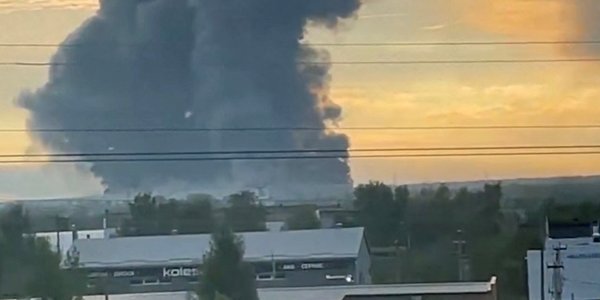
Smoke over Omsk exposes Russia's power myth after 4.5 years of war
Translated from Polish, summarized and contextualized by DistantNews.
At a glance
Analysis
Sources not specified
Context piece
- Russia's unpreparedness for the war in Ukraine is highlighted by its logistical failures and Ukrainian drone attacks reaching deep into Russian territory.
- The article draws parallels between Russia's current struggles and historical events involving Fyodor Dostoevsky and Aleksandr Solzhenitsyn in Siberia.
- The author suggests that smoke over Omsk symbolizes the crumbling myth of Russian power.
Four and a half years into the conflict, it is increasingly evident that Russia was fundamentally unprepared for the war in Ukraine. This unpreparedness extends beyond its nearly 200,000-strong army, which launched multi-pronged offensives from February 24, 2022, across various fronts. It also encompasses the security of its own rear areas, now dramatically exposed by Ukrainian drone attacks.
These attacks have created "spectacular" fires and plumes of smoke across Russia, reaching from St. Petersburg, nearly 900 km from Ukraine's border, to Omsk in Western Siberia, a staggering 2,500 km from the front lines. The straight-line distance between these two cities is approximately 2,700 km, comparable to the distance from Warsaw to Tehran.
As a literary scholar and amateur historian, these vast geographical expanses evoke associations with the young Fyodor Dostoevsky. In St. Petersburg, on December 22, 1849, Dostoevsky and other condemned men faced a firing squad, only to be pardoned at the last moment. His sentence was commuted to four years of hard labor, beginning with a frigid, weeks-long journey to Omsk, where he would later describe his harrowing experiences in "The House of the Dead."
Omsk, a penal city at the confluence of the Om and Irtysh rivers, also hosted Aleksandr Solzhenitsyn. He was there compulsorily in the summer of 1950, a century after Dostoevsky's ordeal, and again voluntarily from July 3-7, 1994, after two decades of exile. A persistent legend among Solzhenitsyn's detractors claims he urged the U.S. Congress to drop an atomic bomb on the USSR. This is false, though it twists his account in "The Gulag Archipelago" of a brief, brutal summer 1950 stay in Omsk en route to the Ekibastuz labor camp in Kazakhstan.
DistantNews Editorial
Originally published by Rzeczpospolita in Polish. Translated, summarized, and contextualized by our editorial team with added local perspective. Read our editorial standards.
More Stories


From Our Blog

What Gets Lost (and Found) When News Is Translated

The Critical Role of Diaspora Media in Global News

What Travellers Should Know About Countries with Restricted Press

A Digital Nomad's Guide to Following Local News

How the Same Story Looks Different in Different Countries
