


Solar Farming: Can it truly belong to farmers?
Translated from Korean, summarized and contextualized by DistantNews.
At a glance
News
Sources not specified
Context piece
- Farmers protest proposed deregulation of renewable energy installations, fearing it will harm agriculture and food security.
- A proposed solution,
Farmers are voicing strong opposition to the South Korean government's plans to ease regulations on renewable energy installations, particularly solar power. They fear the changes will exacerbate existing problems, turning rural areas into "power colonies" and undermining agricultural productivity and food security.
The core of the dispute lies in the "separation distance" regulations, which dictate how far renewable energy facilities must be from residential areas. Experts agree that the current regulations lack scientific basis, but farmers argue that the "threat" they perceive is real. This is largely because many renewable energy facilities have been built on farmland, leading to a significant increase in land conversion for solar power generation over the past decade, especially in rural provinces like North Jeolla, South Jeolla, and North Gyeongsang.
Rural areas are not power colonies.
When solar power facilities are installed on farmland, agricultural activities often become difficult. This has led to reduced income for tenant farmers, decreased agricultural productivity, and concerns about food security. Furthermore, most of the project developers are external investors, meaning the benefits do not directly reach the local farmers, making solar power feel distant from "the farmers' own."
President Lee Jae-myung has acknowledged the potential for "solar farming" to generate more income than working in Seoul, but he emphasized that the "key is the transmission and distribution network," focusing more on the power grid than on integrating it with agriculture. This approach has drawn criticism from farmers who believe the focus should be on ensuring these projects benefit them directly.
Now, if you farm solar power, you can earn more comfortably than working in Seoul. We need to create that situation.
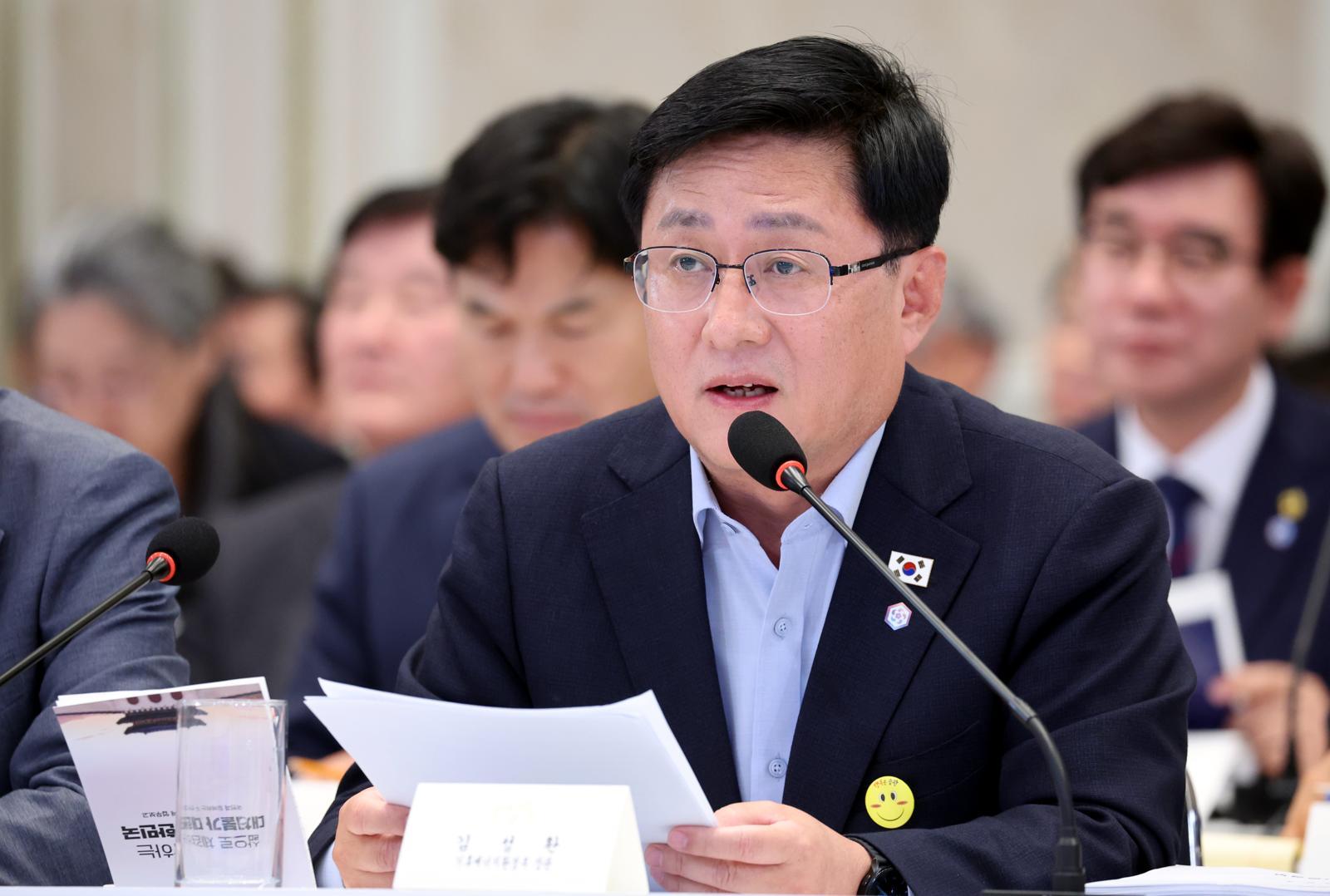
A potential solution lies in "agrovoltaics," a system that combines farming with solar power generation. Kim Chang-han, president of the Korea Agrovoltaic Association, has been experimenting with this model for eight years. His system uses "narrow-type" solar modules with a shading rate of only 30%, allowing sufficient sunlight for crops. The modules are installed at least 3.5 meters high with 4-meter spacing between pillars to accommodate farming machinery. This approach prioritizes farming over power generation, even though it increases installation costs compared to densely packed, standard modules.
Kim envisions this model as a "1 million won monthly farmer's pension," aiming to use power generation facilities as a foundation for farmers to earn a stable income in increasingly threatened rural communities. The association's principles stipulate that "farm land power generation must be permitted only for farmers and only in the agrovoltaic form, with a limit of 100 kW per person." Kim warns that if power generation becomes the primary goal, it will "devour agriculture."
It's fortunate that the Agrovoltaic Special Act was passed last month, even if it's late.
Real-world results from a 600-pyeong (approx. 0.5-acre) demonstration site in Chungbuk show that installing narrow-type modules can generate about 1 million won ($750) in monthly revenue from 100 kW of power. While Japan has allowed agrovoltaics since 2013 under conditions of minimal crop yield reduction, the reality there has been different. 73% of installations were by power developers, and many crops were ornamental plants. In South Korea, a special "Agrovoltaic Special Act" was passed last month and is set to take effect in December, with implementing decrees currently being drafted. Kim expresses relief, calling it "better late than never," and is confident that "farming is definitely possible if done correctly," citing successful cultivation of crops like perilla, sesame, and even tea, with some fruits benefiting from frost protection provided by the modules.
However, the association stresses that clear regulations are crucial to prevent the "devouring of agriculture" seen in Japan. They advocate for a 30% shading limit from narrow-type modules and a 100 kW capacity limit per person. They also propose allowing up to 300 kW for young farmers to help them establish themselves in agriculture, viewing agrovoltaics as a proactive policy tool for designing the future of rural areas.
If done correctly, farming is definitely possible.
DistantNews Editorial
Originally published by Hankyoreh in Korean. Translated, summarized, and contextualized by our editorial team with added local perspective. Read our editorial standards.
More Stories

From Our Blog

What Gets Lost (and Found) When News Is Translated

The Critical Role of Diaspora Media in Global News

What Travellers Should Know About Countries with Restricted Press

A Digital Nomad's Guide to Following Local News

How the Same Story Looks Different in Different Countries
