


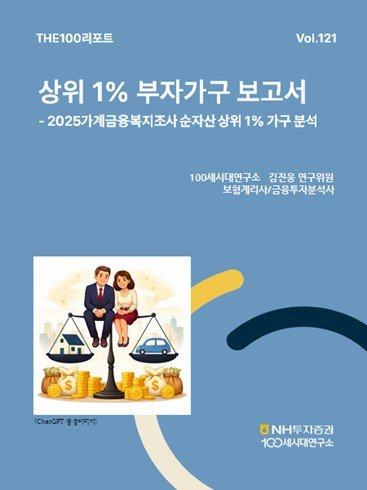
South Korea's 'Top 1%' Defined: Net Worth Over 3.48 Billion Won
Translated from Korean, summarized and contextualized by DistantNews.
TLDR
- The top 1% of households in South Korea possess a net worth of at least 3.48 billion won (approximately $2.5 million USD), an increase of 5.5% from the previous year.
- The average household in this top tier is headed by a 63-year-old, owns assets worth 6.1 billion won, and resides in the Seoul metropolitan area.
- While real estate outside of primary residence constitutes the largest portion of their assets, their income, averaging 243.95 million won, still primarily comes from labor, though the proportion has slightly decreased.
A recent report by NH Investment & Securities' 100-Year Life Institute sheds light on the evolving definition of wealth in South Korea, revealing that a net worth of at least 3.48 billion won (approximately $2.5 million USD) is now required to be among the nation's top 1% of households. This figure represents a 5.5% increase from the previous year, indicating a growing concentration of wealth.
The typical profile of a household within this elite group is a 63-year-old head of household with an average net worth of 6.08 billion won. These households are predominantly located in the Seoul metropolitan area, with an average of 2.84 members. Their total assets have grown by approximately 11% year-on-year, reaching an average of 6.74 billion won.
Interestingly, while non-residential real estate makes up a significant 57.9% of their assets, a slight decrease in the proportion of financial assets (down to 15.3% from 18.9%) suggests a continued emphasis on tangible assets. Despite this, the primary source of income for these affluent households remains labor, averaging 243.95 million won annually, although the share of earned income has marginally dipped to 44.4%.
Lee Jae-kyung, Vice President of NH Securities' Channel Solution Division, commented on the report, acknowledging that the definition of wealth is relative but emphasizing the public's curiosity about objective benchmarks. He expressed hope that this analysis of the top 1% of South Korean households will serve as a valuable resource for individuals seeking to improve their asset management strategies and potentially ascend to the ranks of the wealthy.
From a South Korean perspective, this report is more than just a statistical snapshot; it reflects the nation's rapid economic development and the increasing stratification of wealth. While Western media might focus on the sheer numbers, for many Koreans, this data provides a tangible, albeit aspirational, target. It fuels discussions about economic mobility, investment strategies, and the long-term financial planning necessary to navigate an increasingly competitive landscape. The slight shift towards real estate and the continued reliance on labor income offer insights into local investment trends and the persistent value placed on active earning, even among the wealthiest.
DistantNews Editorial
Originally published by Dong-A Ilbo in Korean. Translated, summarized, and contextualized by our editorial team with added local perspective. Read our editorial standards.
More Stories


From Our Blog

What Gets Lost (and Found) When News Is Translated

The Critical Role of Diaspora Media in Global News

What Travellers Should Know About Countries with Restricted Press

A Digital Nomad's Guide to Following Local News

How the Same Story Looks Different in Different Countries
