


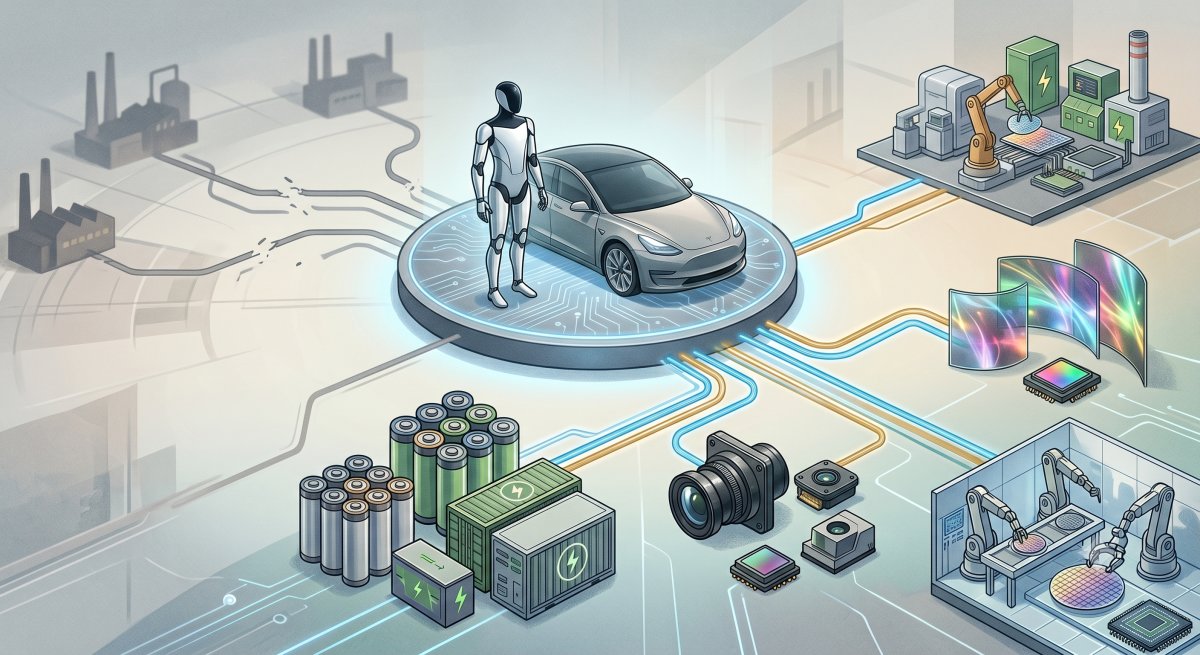
South Korean Firms Become Key Tesla Partners in Battery and Robotics
Translated from Korean, summarized and contextualized by DistantNews.
At a glance
News
Named sources
Context piece
- Tesla is expanding its supply chain to include South Korean companies, particularly in batteries and robotics, shifting away from its previous reliance on China.
- LG Energy Solution and Samsung SDI are increasing battery production for Tesla's electric vehicles and energy storage systems, while Samsung Electro-Mechanics and LG Innotek are key suppliers for Tesla's humanoid robot, Optimus.
- This strategic shift leverages South Korean technological expertise and aims to mitigate risks associated with the prolonged US-China trade conflict, positioning Korean firms as crucial partners in Tesla's ecosystem.
Tesla is significantly reshaping its global supply chain, increasingly partnering with South Korean companies for critical components in electric vehicles, energy storage systems, and its burgeoning humanoid robot project. This strategic pivot away from a China-centric model is driven by the ongoing US-China trade tensions and Tesla CEO Elon Musk's desire to diversify its supplier base.
The supply chain scale will grow, and it will be difficult for the China-centric supply chain to remain as it is. Especially for actuators and hand-related parts, Tesla is likely to maintain direct control.
In the battery sector, LG Energy Solution and Samsung SDI are emerging as key partners. LG Energy Solution has secured a substantial $4.3 billion contract to supply lithium iron phosphate (LFP) batteries, crucial for both electric vehicles (EVs) and energy storage systems (ESS), to Tesla. Notably, LG Energy Solution has been the primary battery supplier for Tesla vehicles sold in Europe for the past five years. Samsung SDI is also set to supply LFP batteries starting in 2027.
The collaboration extends to advanced robotics, with Samsung Electro-Mechanics and LG Innotek positioned as vital suppliers for Tesla's humanoid robot, Optimus. Samsung Electro-Mechanics is preparing to mass-produce components for Optimus V3, while LG Innotek is developing integrated sensor modules, including cameras and LiDAR, for the robot. This expansion into robotics signifies Tesla's commitment to leveraging Korean technological prowess beyond its automotive and energy divisions.
Tesla's global electric vehicle sales have contracted for the past two years, but are estimated to grow 8% this year. The recovery of Tesla's EV sales and the expansion of ESS are already having a positive impact on K-batteries.
Display technology is another area of deepening cooperation. LG Display has supplied OLED and other automotive displays for Tesla vehicles since 2016. Samsung Display is now a contender to supply OLED panels for Optimus's head-mounted display, further integrating Korean firms into Tesla's next-generation products. Experts predict that as Optimus production scales up, the role of Korean companies will grow, especially in specialized components like actuators and hand parts, as Tesla pursues supply chain de-risking.
We plan to supply products for new robotaxis in the second quarter and for humanoid robots in the second half.
DistantNews Editorial
Originally published by Dong-A Ilbo in Korean. Translated, summarized, and contextualized by our editorial team with added local perspective. Read our editorial standards.
More Stories

From Our Blog

What Gets Lost (and Found) When News Is Translated

The Critical Role of Diaspora Media in Global News

What Travellers Should Know About Countries with Restricted Press

A Digital Nomad's Guide to Following Local News

How the Same Story Looks Different in Different Countries
