


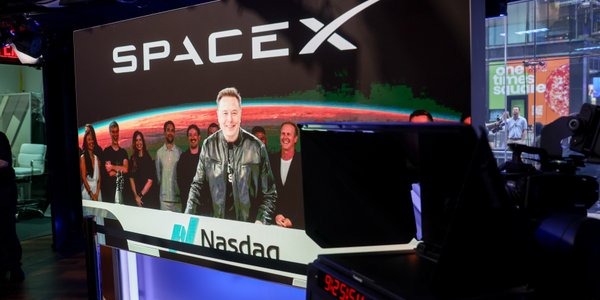
SpaceX IPO Soars, Valuing Company at $2.1 Trillion
Translated from Polish, summarized and contextualized by DistantNews.
At a glance
News
Sources not specified
New plan
- SpaceX's initial public offering (IPO) was a major success, with shares surging significantly on their first day of trading.
- The company's market capitalization reached $2.1 trillion, placing it among the world's largest firms, despite reporting significant losses.
- Analysts suggest investors are willing to pay a premium for SpaceX's future potential, similar to early investments in industrial revolutions.
SpaceX's debut on the stock market proved a resounding triumph for its existing shareholders, with shares experiencing immense demand during the public offering and soaring as much as 30% above the IPO price on the first day of trading. The fervor for SpaceX shares was so intense that the stock's introduction to trading was delayed by approximately two hours past the opening of the cash market. This level of buying frenzy echoed the highly anticipated IPOs of Google in 2004 and Meta (Facebook's parent company) in 2012. Once trading commenced, SpaceX shares surged by over a dozen percent from their IPO price of $135. In subsequent hours, the space company's stock continued to climb, reaching a high of $176.52. Ultimately, Friday's trading closed around $161, marking a gain of over 19% by the session's end. The company's valuation thus reached $2.1 trillion, positioning SpaceX among the six largest companies globally, even surpassing Tesla, another Elon Musk venture. "It's almost surreal to watch a company I joined when it was just sketches on paper become so valuable," said Tom Mueller, a SpaceX founder with 18 years at the company and now president of Impulse Space, a space-sector startup. The IPO successfully raised $75 billion for SpaceX, making it the largest public offering in capital markets history, nearly tripling the previous record set by Saudi Aramco in 2019. However, it appears Elon Musk might have sold SpaceX shares at a considerably lower price. Demand for shares in the public offering was reportedly three to four times higher than the supply. Furthermore, on the debut day, investors eagerly acquired SpaceX shares without apparent concern for the company's seemingly exorbitant valuation. Over 510 million shares, valued at approximately $84 billion, changed hands on the first trading day. This occurred despite SpaceX remaining unprofitable and generating only a fraction of the revenue of similarly valued tech giants. Concerns about the valuation were already present at $135 per share, equating to a $1.75 trillion market capitalization for a company that reported a net loss of $4.9 billion last year. Projections for this year indicate SpaceX will achieve $30.9 billion in revenue, with a reduced net loss of $1.8 billion. Profitability is not expected until next year, with projected revenues of $49.6 billion. "Many SpaceX investors see it as akin to investing in railroads during the Industrial Revolution and are willing to pay a premium to Elon Musk for that opportunity," explained Seth Hickle, director of investment at Mindset Wealth Management in Indianapolis, as quoted by Reuters. "Right now, people are banking on the stock price continuing to go up because that's all they see at the moment. Time will tell if that holds true," he added.
It's almost surreal to watch a company I joined when it was just sketches on paper become so valuable.
DistantNews Editorial
Originally published by Rzeczpospolita in Polish. Translated, summarized, and contextualized by our editorial team with added local perspective. Read our editorial standards.
More Stories



From Our Blog

What Gets Lost (and Found) When News Is Translated

The Critical Role of Diaspora Media in Global News

What Travellers Should Know About Countries with Restricted Press

A Digital Nomad's Guide to Following Local News

How the Same Story Looks Different in Different Countries
