

Spain's Ceuta Border Crisis Fuels European Political Debate, Boosts Le Pen's Prospects
Translated from Romanian, summarized and contextualized by DistantNews.
At a glance
News
Sources not specified
Context piece
- A surge of over 60,000 Moroccan citizens crossing into Spain's Ceuta enclave highlights the EU's border vulnerability and reignites sensitive political debates.
- The incident is viewed by some European leaders as a public order issue, while others see it as a potential turning point that could benefit Marine Le Pen's presidential ambitions.
- Migration is increasingly framed as a security concern, with several EU interior ministers demanding stricter measures, though some Western European nations advocate a different approach.
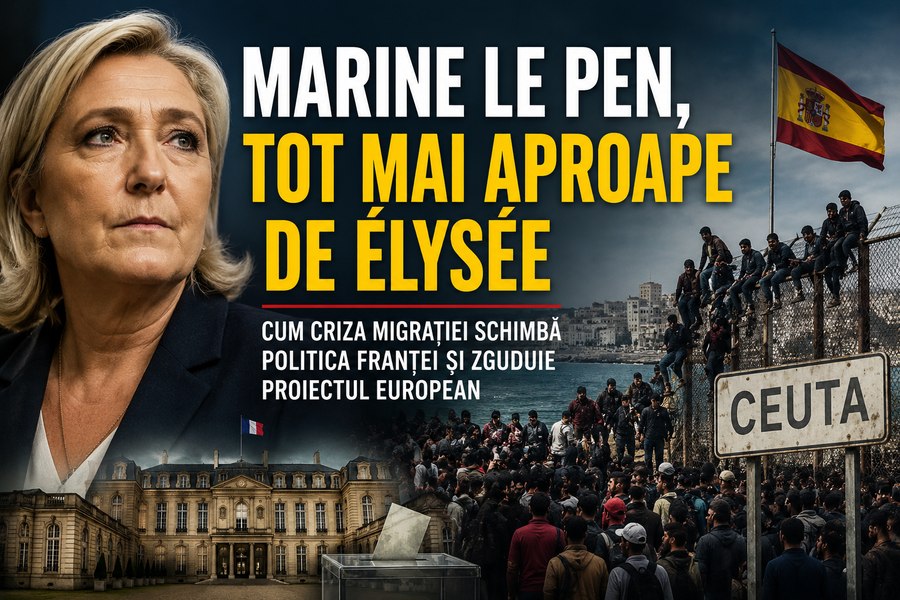
A recent influx of over 60,000 Moroccan citizens into Spain's Ceuta enclave has exposed the European Union's border vulnerabilities and intensified political discussions across the continent. While Spanish authorities emphasized that most individuals returned home, the event underscored the fragility of an EU border that Brussels claims to control. This incident has reignited one of Europe's most sensitive political debates, with implications reaching far beyond Spain.
For some European leaders, the situation is primarily a matter of public order. However, others perceive it as a pivotal moment that could reshape Europe's political landscape and potentially pave the way for Marine Le Pen's ascent to the Élysée Palace. The sheer volume of people crossing the border in a short period has made migration a central security issue, testing the EU's capacity to manage its external frontiers. The repercussions were immediately felt in Brussels, Rome, Copenhagen, and Paris.
The crisis in Ceuta is not an isolated event. In recent years, migration has increasingly been weaponized as a tool of geopolitical pressure. Belarus used migrants against Poland and Lithuania, Turkey has repeatedly threatened to open migration routes, and Morocco has previously leveraged Ceuta and Melilla as diplomatic leverage against Madrid and Brussels. This shift transforms migration from a humanitarian or social issue into a national security concern, with borders becoming arenas for geopolitical competition.
This heightened security perspective has led to a strong reaction from Brussels. At the urging of Italy and Denmark, twenty-two interior ministers called for an extraordinary meeting and sent a firm letter to European Commission President Ursula von der Leyen. The ministers stressed the EU's obligation to "effectively discourage and relentlessly combat illegal migration," using unusually strong language. Notably, France, Spain, Portugal, Luxembourg, and Ireland did not sign the letter, highlighting a division in approach among Western European governments, largely along center-left and left-wing political lines.
The Union's obligation to 'effectively discourage and relentlessly combat illegal migration.'
DistantNews Editorial
Originally published by Adevărul in Romanian. Translated, summarized, and contextualized by our editorial team with added local perspective. Read our editorial standards.
More Stories


From Our Blog

What Gets Lost (and Found) When News Is Translated

The Critical Role of Diaspora Media in Global News

What Travellers Should Know About Countries with Restricted Press

A Digital Nomad's Guide to Following Local News

How the Same Story Looks Different in Different Countries
