


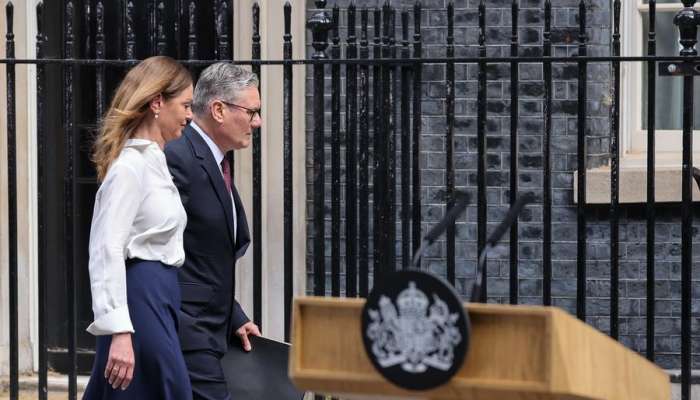
Starmer's exit leaves Britain's deeper political problems unresolved
Summarized and contextualized by DistantNews.
At a glance
News
Named sources
Ongoing story
- British Prime Minister Keir Starmer announced his resignation as leader of the Labour Party, citing mounting internal pressure and governing difficulties.
- Starmer's tenure was marked by policy reversals and controversies, including links to Jeffrey Epstein, and followed significant Labour losses in recent local elections.
- Andy Burnham, recently elected to Parliament, is considered the front-runner to succeed Starmer, who led Labour to a surprise election victory in 2024.
British Prime Minister Keir Starmer announced Monday he will resign as leader of the governing Labour Party once a successor is chosen, ending a tumultuous tenure. His departure, less than two years after leading Labour to a surprise landslide election victory that ended 14 years of Conservative rule, exposes deep governing difficulties and prolongs political instability in Britain.
If you don't have the command of your parliamentary party, you really are in trouble as a prime minister.
Analysts attribute Starmer's resignation to mounting pressure within the party, exacerbated by significant Labour losses in May's local and regional elections. Reform UK challenged Labour from the right on immigration, while the Green Party attracted disillusioned voters on the left. The controversy surrounding former British Ambassador Peter Mandelson's links to the late US financier Jeffrey Epstein also damaged Starmer's political judgment.
Starmer entered Downing Street in July 2024 promising economic growth and improved public services. However, his government struggled to balance spending limits with demands for social investment. Policy reversals on issues like winter fuel payments and disability benefits drew criticism for a lack of clear direction. The departure of senior Downing Street aides further eroded confidence.
Starmer had succeeded in transforming Labour from a party widely considered unelectable after its 2019 defeat into the 2024 general election winner. However, he was unable to transfer that success into governance, with repeated policy reversals and "unforced errors" steadily eroding his authority.
Stuart Wilks-Heeg, a political expert at the University of Liverpool, noted that a prime minister needs the support of their parliamentary party. While Starmer successfully transformed Labour into an election-winning force, he failed to translate that into effective governance, with repeated policy reversals and "unforced errors" undermining his authority.
Starmer could no longer remain in office once large numbers of Labour lawmakers and senior cabinet members concluded that he had to go.
Andy Burnham, the recently elected mayor of Greater Manchester, has emerged as the front-runner to succeed Starmer. Burnham, who previously served as culture and health secretary, has expressed willingness to participate in the selection process after returning to the House of Commons.
On Monday, he voiced willingness to be "part of this process," referring to the selection of Starmer's successor.
DistantNews Editorial
Originally published by Times of Oman. Summarized and contextualized by our editorial team with added local perspective. Read our editorial standards.
More Stories
From Our Blog

What Gets Lost (and Found) When News Is Translated

The Critical Role of Diaspora Media in Global News

What Travellers Should Know About Countries with Restricted Press

A Digital Nomad's Guide to Following Local News

How the Same Story Looks Different in Different Countries
