


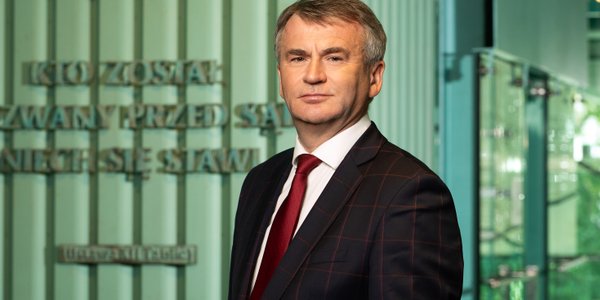
Supreme Court Chief Says He Is Ready to Meet and Work With Justice Minister Żurek
Translated from Polish and summarized by DistantNews. Read the original for the full story.
At a glance
Interview
Named sources
Ongoing story
- Polish Supreme Court First President Zbigniew Kapiński proposes a short law confirming the validity of judicial appointments since 1990 and barring challenges to them.
- Kapiński says political leaders have shown no interest in advancing the proposal, which he presents as a constitutional way to address disputes over judges' status.
- He rejects Justice Minister Waldemar Żurek's criticism and says he remains willing to meet and seek solutions for Poland's judiciary.
Zbigniew Kapiński says he is ready to sit down with Justice Minister Waldemar Żurek, even as Żurek questions whether Kapiński is a lawful Supreme Court judge and first president.
It would be enough to pass a short, virtually one-sentence law confirming the validity of judicial appointments from 1990 to the present and prohibiting challenges to them.
Kapiński has spent several months advocating a short law that would confirm the validity of judicial appointments made from 1990 to the present and prohibit challenges to them. He says the proposal could resolve the dispute over judges' status, including questions about the National Council of the Judiciary's procedures before 2017. In his view, the measure would comply with both Polish and European law.
The Supreme Court chief says no politician has yet discussed the idea with him. He plans to seek talks with the president and the justice minister after the summer. He also points to the European Court of Human Rights case Wałęsa v. Poland, saying it requires Polish authorities to address the problem surrounding judges' status.
Politicians do not want to solve the problem affecting the justice system.
Kapiński rejects criticism that he wants the law to validate his own position. He says he has served as a judge for 36 years and received positive assessments from different National Council of the Judiciary panels four times, including unanimous support for his 2022 appointment to the Supreme Court. He argues that Żurek's proposed approach, involving the verification of judges, would violate the Constitution and make judges directly dependent on political power. In his view, successive governments could repeat such reviews, causing what he calls a catastrophe for the Polish state.
I am ready to meet with Minister Waldemar Żurek and work out solutions that are good for Poland.
Despite the dispute, Kapiński says he has no obstacle to meeting Żurek and developing solutions that would serve Poland. He leaves open the question of whether the minister is equally willing to meet.
If we carry out a verification of judges in Poland once, subsequent political authorities will use it and further verifications will follow.
About this summary
Originally published by Rzeczpospolita in Polish. Translated, summarized, and contextualized automatically by DistantNews, with a note on how the source frames the story. Not individually reviewed before publishing. How this works.
More Stories

From Our Blog

What Gets Lost (and Found) When News Is Translated

The Critical Role of Diaspora Media in Global News

What Travellers Should Know About Countries with Restricted Press

A Digital Nomad's Guide to Following Local News

How the Same Story Looks Different in Different Countries
