


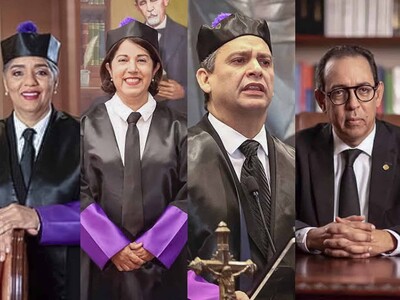
Supreme Court Judges' Evaluation Under Shadow of Resignations
Translated from Spanish, summarized and contextualized by DistantNews.
At a glance
News
Sources not specified
Context piece
- Four judges, including the president of the Supreme Court of Justice, have declined to undergo evaluation by the National Council of the Judiciary.
- The judges' refusal to participate in the evaluation process, which lacks an objective scoring system, has drawn scrutiny.
- This simultaneous departure follows a previous evaluation that led to the exclusion of three other judges, raising questions about the process's fairness and transparency.
Four judges from the Supreme Court of Justice, including its president, have opted out of undergoing evaluation by the National Council of the Judiciary (CNM). This decision places a procedure that lacks objective scoring under renewed scrutiny, despite established rules and parameters. Public records do not clearly show how technical indicators translate into final decisions to confirm or dismiss magistrates.
Alongside Luis Henry Molina, Nancy Salcedo Fernández, María Gerinelda Garabito Ramírez, and Manuel Ramón Herrera Carbuccia, the first substitute for the Supreme Court president, also declined the evaluation. While the judges publicly stated no dissatisfaction with the evaluation system, Herrera Carbuccia had previously announced his intention to retire upon completing his second term. However, the simultaneous departure of four judges is significant, occurring less than a year after an evaluation resulted in the exclusion of Pilar Jiménez Ortiz, Manuel Alexis Read Ortiz, and Moisés Ferrer Landrón.
Explanations for the previous exclusions were not immediately provided, with individualized reasons appearing weeks later in the CNM's minutes. In Pilar Jiménez's case, a tie vote was broken by President Luis Abinader, with criticisms including her handling of new cassation legislation and delays in certain suspension requests. Notably, during Jiménez's presidency, her chamber had reduced a backlog of cases. Moisés Ferrer also faced a tied vote decided by Abinader. Manuel Alexis Read's case involved professional recognition but was impacted by his proximity to the constitutional retirement age of 75, introducing age as a debatable factor in performance evaluation.
Civil society organizations have questioned the alignment between favorable technical reports and the CNM's final decisions. Article 181 of the Constitution mandates that Supreme Court judges undergo this evaluation.
But the simultaneous departure of four magistrates takes on another dimension because it occurs less than a year after an evaluation that ended with the exclusion of Pilar Jiménez Ortiz, Manuel Alexis Read Ortiz and Moisés Ferrer Landrón.
DistantNews Editorial
Originally published by Diario Libre in Spanish. Translated, summarized, and contextualized by our editorial team with added local perspective. Read our editorial standards.
More Stories

From Our Blog

What Gets Lost (and Found) When News Is Translated

The Critical Role of Diaspora Media in Global News

What Travellers Should Know About Countries with Restricted Press

A Digital Nomad's Guide to Following Local News

How the Same Story Looks Different in Different Countries
