


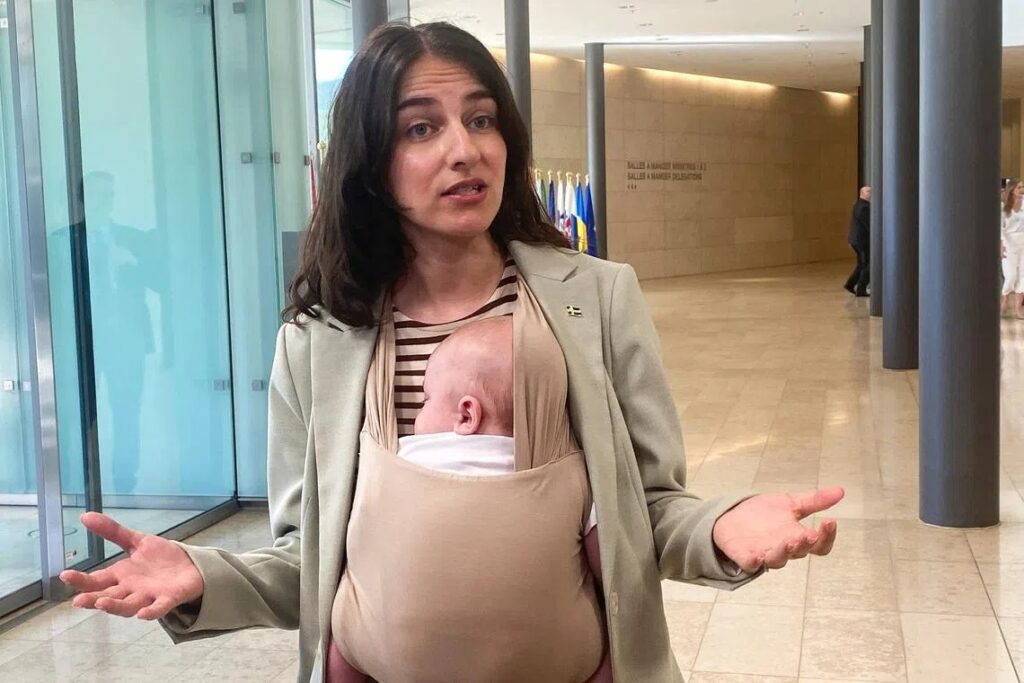
Swedish Minister Brings Baby to EU Meeting, Championing Work-Life Balance
Translated from Malay, summarized and contextualized by DistantNews.
At a glance
News
From a news agency
Context piece
- Swedish Climate Minister Romina Pourmokhtari brought her three-month-old son to an EU meeting, becoming the first baby to attend such a ministerial-level session.
- Pourmokhtari aims to show that women do not have to choose between family and career, highlighting the importance of supportive parental leave policies.
- Her action received widespread praise on social media, seen as an inspiration for working mothers and a symbol of work-life balance.
Swedish Climate Minister Romina Pourmokhtari made waves on social media last month by bringing her three-month-old son to a European Union (EU) meeting, marking the first time a baby has attended a ministerial-level EU session.
Pourmokhtari intentionally brought her son, Adam, to convey a message that women should not have to choose between building a family and pursuing a career, especially in public service. She emphasized that robust parental leave policies are crucial for balancing these responsibilities. "I want to show by example that women do not have to make that choice. Of course, it also requires a partner who is not old-fashioned, but rather modern and willing to play a role," she told Reuters.
Speaking to the media before the meeting, Pourmokhtari expressed hope that her presence with Adam would encourage more women to remain active in their careers after becoming mothers. She also stressed that family-friendly policies in Europe enable parents to balance childcare with professional careers. Pourmokhtari noted that the practice of fathers taking parental leave is now widely accepted in Sweden, a shift attributed to changing societal attitudes and the country's emphasis on shared parenting.
The minister's action garnered widespread praise on social media, with many users calling her an inspiration to working mothers and a symbol of work-life balance. Sweden offers one of the world's most generous parental leave systems, providing approximately 16 months of paid leave after a child's birth. Under this policy, mothers are entitled to 90 days of special leave, and fathers also receive 90 days of special leave. The remaining 300 days can be shared by both parents as they see fit. The quota of special leave for fathers, known as 'Dad Months,' was introduced to encourage greater paternal involvement in childcare.
Romina Pourmokhtari, who was elected to the Swedish Parliament in 2022 and appointed Climate Minister the same year, becoming the youngest minister in the country's history, had recently returned to work after her special leave. Her husband is currently on parental leave until the Swedish parliamentary elections in September. He accompanied her to Luxembourg and cared for Adam during the EU meeting on climate policy. Pourmokhtari is not the first female leader to bring a child to work or an official event as a symbol of support for a family-friendly work environment; in 2010, European Parliament member Licia Ronzulli attended a parliamentary session with her six-week-old daughter.
I want to show by example that women do not have to make that choice. Of course, it also requires a partner who is not old-fashioned, but rather modern and willing to play a role.
DistantNews Editorial
Originally published by Utusan Malaysia in Malay. Translated, summarized, and contextualized by our editorial team with added local perspective. Read our editorial standards.
More Stories

From Our Blog

What Gets Lost (and Found) When News Is Translated

The Critical Role of Diaspora Media in Global News

What Travellers Should Know About Countries with Restricted Press

A Digital Nomad's Guide to Following Local News

How the Same Story Looks Different in Different Countries
