


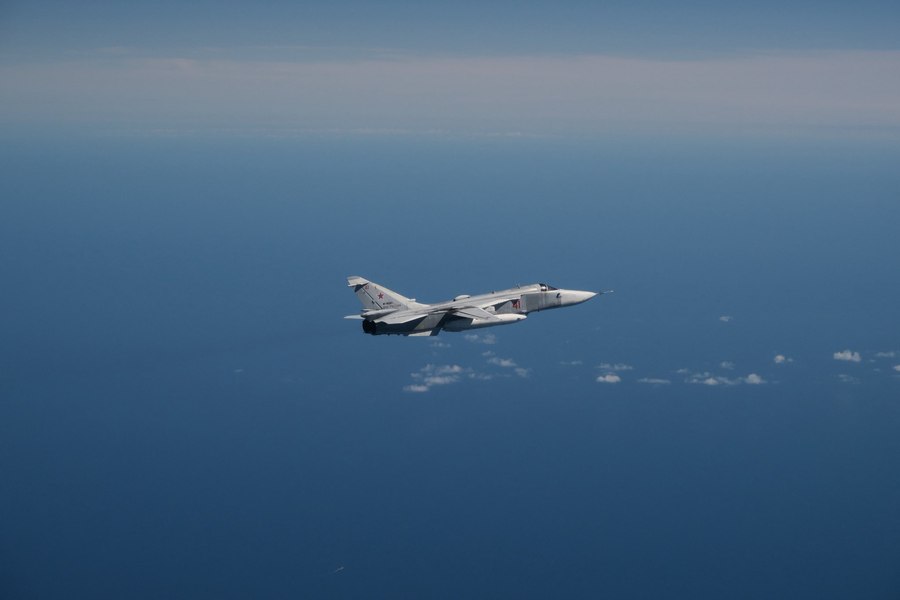
Tensions in the Baltic Sea. Sweden intercepted Russian planes twice near its airspace
Translated from Romanian, summarized and contextualized by DistantNews.
At a glance
News
Named sources
Context piece
- Swedish fighter jets intercepted two Russian aircraft, identified as Su-24 Fencer and Su-34 Fullback, over the Baltic Sea near Swedish airspace.
- The Swedish Air Force scrambled JAS 39 Gripen jets twice to escort the Russian planes, ensuring Swedish airspace remained unviolated.
- The incident occurs amid heightened tensions and a Swedish parliamentary report warning of potential Russian actions to test NATO's cohesion following Sweden's accession to the alliance.
The Swedish Air Force scrambled fighter jets twice on Friday to intercept and identify Russian military aircraft operating in the vicinity of Swedish airspace over the Baltic Sea. The Swedish Armed Forces reported that two Russian combat planes, a Su-24 Fencer and a Su-34 Fullback, were involved in the encounters.
On Friday, the Swedish reaction force carried out two missions with JAS 39 Gripen aircraft to deal with Russian fighter jets in the Baltic Sea, close to Swedish airspace. Two Russian fighter jets, a Su-24 Fencer and a Su-34 Fullback, were involved in the incidents.
Swedish JAS 39 Gripen jets were deployed rapidly in response to the detected Russian flights. The mission aimed to defend national territory and escort the foreign aircraft, with the Swedish Air Force confirming that Swedish airspace was not breached during these incidents. This rapid response highlights the need for continuous operational readiness, according to Swedish officials.
Russia's repeated behavior in the Baltic Sea is worrying.
Prime Minister Ulf Kristersson described Russia's repeated actions in the Baltic Sea as "worrying." He emphasized that the swift intervention by the Swedish Air Force underscores the importance of maintaining daily operational alertness. While no airspace violation occurred, the incident serves as a reminder of the volatile security situation and the necessity for Sweden, alongside its NATO allies, to remain vigilant in detecting, identifying, and intercepting potential threats.
The rapid intervention of the air force demonstrates why daily operational alert is necessary.
The encounters come at a time of heightened regional tensions. A recent report from Sweden's parliamentary Defence Committee warned that Russia might launch operations to test NATO's solidarity in the near future, particularly if political circumstances are deemed favorable. The report did not rule out the possibility of an attack on Sweden or its allies, stressing the risk of Russian military operations designed to probe the alliance's cohesion. Sweden joined NATO in 2024, ending over two centuries of military neutrality, and plans to increase defense spending to 3.5% of GDP by 2030.
The report warns that an attack against Sweden or its allies cannot be ruled out and emphasizes the risk of Russian military operations aimed at testing the North Atlantic Alliance's cohesion.
DistantNews Editorial
Originally published by Adevărul in Romanian. Translated, summarized, and contextualized by our editorial team with added local perspective. Read our editorial standards.
More Stories


From Our Blog

What Gets Lost (and Found) When News Is Translated

The Critical Role of Diaspora Media in Global News

What Travellers Should Know About Countries with Restricted Press

A Digital Nomad's Guide to Following Local News

How the Same Story Looks Different in Different Countries
