

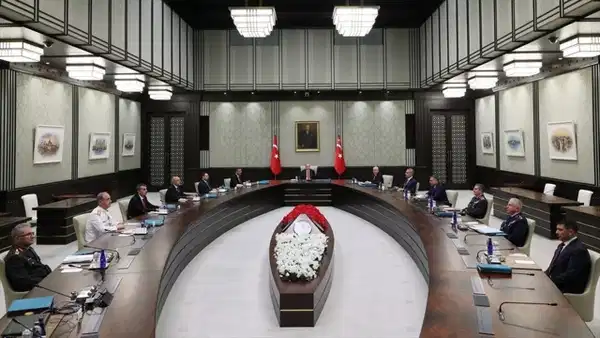

Terrorism's $2 trillion cost to Turkey: Peace expected to spur economic growth
Translated from Turkish, summarized and contextualized by DistantNews.
At a glance
News
Named sources
New plan
- Turkey has submitted a 12-point framework law to parliament aimed at ending terrorism, a move supported by President Erdoğan and MHP leader Bahçeli.
- The cost of terrorism to Turkey is estimated at $2 trillion, with potential economic benefits from peace including increased investment and employment.
- Experts anticipate significant growth in agriculture, tourism, and trade in eastern and southeastern Turkey once security improves.
Turkey has taken a significant step towards ending its long-standing struggle with terrorism by submitting a 12-point framework law to the Grand National Assembly. This initiative, shaped by the determination of President Recep Tayyip Erdoğan and MHP leader Devlet Bahçeli, is poised to bring about substantial political, social, and economic transformations for the nation.
The cost of terrorism is over 2.3 trillion dollars.
Research indicates that terrorism has exacted a staggering toll on Turkey, with an estimated economic cost of $2 trillion. The proposed measures aim to usher in an era of peace and security, which is expected to unlock the country's full economic potential. Proponents believe that the resulting climate of trust and tranquility will foster greater domestic prosperity, boost investment, and create more employment opportunities.
The cost of terrorism to Turkey's economy is clearly shown by a recent study by our party's economy department. The bill for terrorism amounts to $511 billion in gross domestic product, $5,800 per capita income, and $110 billion in exports. The loss in employment reaches 2.5 million people. Our cumulative borrowing cost over 40 years is $520 billion, and our tax loss is approaching $123 billion. Turkey's bill is over $2.3 trillion.
President Erdoğan highlighted the immense financial burden of terrorism in a recent address, stating that a study by his party's economy department placed the cost at over $2.3 trillion. This figure encompasses $511 billion in lost GDP, $5,800 per capita in lost income, and $110 billion in lost exports. The cumulative debt burden over 40 years has reached $520 billion, with tax losses nearing $123 billion. The opportunity cost of terrorism, he noted, is nearly double this direct financial impact.
When we look at opportunity costs, the country's economic loss due to terrorism is almost double this figure.
Beyond the quantifiable economic losses, the human and sociological costs are immeasurable. Experts are optimistic that the "Terror-Free Turkey" process will catalyze a historic leap forward in key sectors. They predict substantial growth in agriculture, tourism, and border trade, particularly in the eastern and southeastern regions of Turkey, which possess vast, fertile lands that have been underutilized due to prolonged insecurity. The improved security environment is expected to unlock this potential, driving economic development and enhancing the quality of life for citizens.
According to research, the implicit and indirect costs of terrorism on the Turkish economy through macro-indicators such as private sector initiative and investment decisions, foreign direct investment inflow, export volume, and tourism demand amount to approximately $2 trillion.
DistantNews Editorial
Originally published by Sabah in Turkish. Translated, summarized, and contextualized by our editorial team with added local perspective. Read our editorial standards.
More Stories
From Our Blog

What Gets Lost (and Found) When News Is Translated

The Critical Role of Diaspora Media in Global News

What Travellers Should Know About Countries with Restricted Press

A Digital Nomad's Guide to Following Local News

How the Same Story Looks Different in Different Countries
