


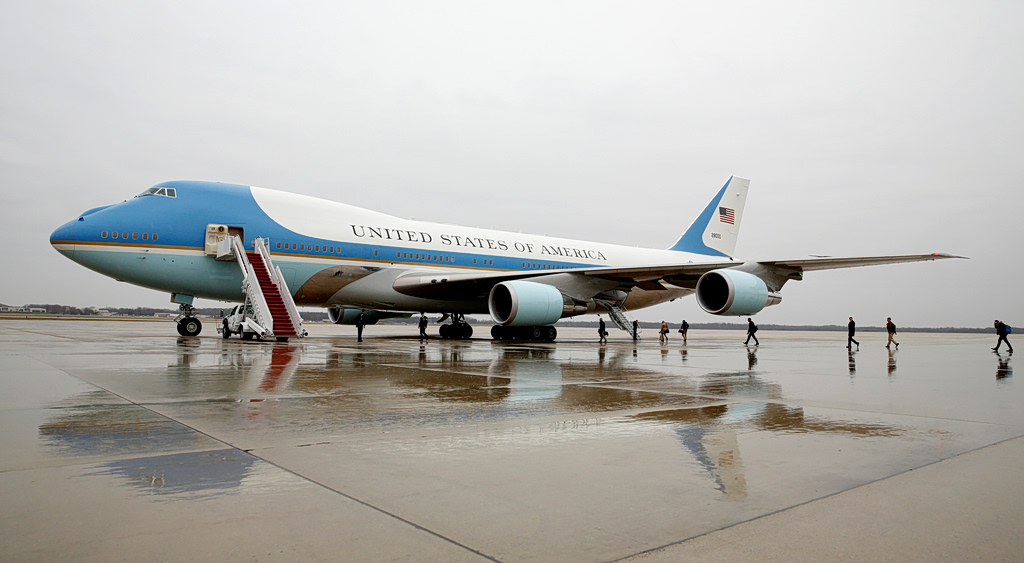
The Mammoth Boeing: A Gift from Qatar - How it's Being Transformed from a 'Flying Palace' into an Air Force One
Translated from Greek, summarized and contextualized by DistantNews.
TLDR
- A luxurious Boeing 747-8, formerly owned by the Emir of Qatar, is being converted into a temporary presidential aircraft for the US.
- The aircraft, valued at $300 million, is undergoing testing in Texas and is expected to be delivered by summer 2026.
- While it will serve presidential duties, it lacks full defensive capabilities and aerial refueling, suggesting it will be used in lower-risk environments.
In a remarkable display of rapid technological adaptation, the United States is transforming a former Qatari royal's "flying palace"—a $300 million Boeing 747-8—into a temporary presidential aircraft. This ambitious project, underway in Texas, signifies a unique solution to bolster the Air Force One fleet while new aircraft are developed. Ta Nea is following this fascinating story, which highlights the intricate process of converting a luxury jet into a functional command center.
One of the most impressive aviation projects of recent years is in full swing in the United States, as a super-luxury Boeing 747-8, worth about 300 million dollars, which belonged to the Emir of Qatar, is being converted with rapid procedures into a temporary presidential aircraft, strengthening the Air Force One fleet.
The aircraft, previously outfitted with opulent lounges and marble bathrooms, is now undergoing rigorous testing by L3Harris Technologies. The focus is not on flashy maneuvers but on absolute reliability. Engineers are meticulously examining flight controls, electrical systems, cabin pressure, autopilot, and communications—critical elements for an aircraft carrying the US political leadership. The complexity extends to integrating new antennas and secure communication spaces without causing interference, and managing the significant shift in weight distribution that affects aerodynamics and system performance.
The aircraft, which until recently functioned as a 'flying palace' with high-aesthetic lounges, marble bathrooms, and fully equipped kitchens, is already in the testing phase in Texas, with its delivery expected by the summer of 2026.
While the conversion is impressive, it comes with limitations. Unlike the standard Air Force One, this temporary version reportedly lacks a full defensive system and the crucial aerial refueling capability that provides virtually unlimited range. Furthermore, advanced technologies like protection against electromagnetic pulses are difficult to retrofit. Consequently, while capable of presidential missions, it is likely to be deployed in lower-risk scenarios. The temporary call sign "Vader 01" during testing adds a touch of pop culture flair to this high-stakes operation.
The tests are carried out by the facilities of L3Harris Technologies and are a critical stage, as they do not focus on impressive maneuvers, but on the absolute reliability of the aircraft.
From our perspective at Ta Nea, this story is more than just an aviation upgrade; it's a glimpse into the practicalities of presidential logistics and the ingenuity required to meet geopolitical needs. The fact that such a conversion is happening so rapidly, and that a former symbol of extreme luxury is being repurposed for national security, is particularly noteworthy. It underscores the adaptability of technology and the often-unseen efforts to ensure continuity of government, even if it means relying on a "backup" that, while impressive, doesn't quite match the full capabilities of the established presidential fleet. The project demonstrates a pragmatic approach, balancing immediate needs with long-term strategic goals.
Engineers are meticulously examining the behavior of the flight controls, the stability of the electrical systems, cabin pressure, the operation of the autopilot, and the reliability of communications, as in an aircraft intended to carry the political leadership of the USA, even the slightest failure can have critical consequences.
DistantNews Editorial
Originally published by Ta Nea in Greek. Translated, summarized, and contextualized by our editorial team with added local perspective. Read our editorial standards.
More Stories


From Our Blog

What Gets Lost (and Found) When News Is Translated

The Critical Role of Diaspora Media in Global News

What Travellers Should Know About Countries with Restricted Press

A Digital Nomad's Guide to Following Local News

How the Same Story Looks Different in Different Countries
