


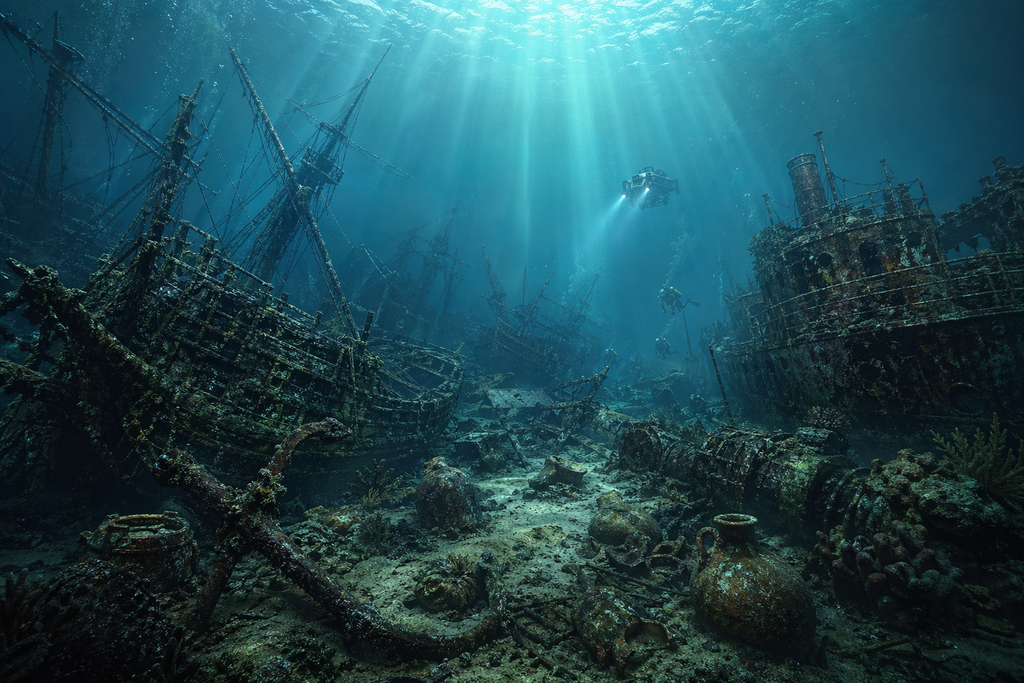
This is the maritime 'graveyard' that 'swallowed' over 130 ships - From the Islamic Middle Ages to the warships of the 18th century
Translated from Greek, summarized and contextualized by DistantNews.
TLDR
- Spanish archaeologists have discovered over 130 shipwrecks in a bay near Gibraltar, dating from the 5th century BC to World War II.
- The site, identified with the ancient Pillars of Hercules, has been a crucial maritime passage for millennia, witnessing trade, war, and exploration.
- Among the findings are Phoenician, Roman, and later European vessels, including an 18th-century Spanish gunship and a 1930s aircraft engine.
A remarkable underwater 'cemetery' has been unveiled by Spanish archaeologists in the waters between Algeciras and the Rock of Gibraltar, a historically significant strait that has served as a vital crossroads for civilizations. This extensive discovery, part of the three-year 'Project Herakles' by the University of Cadiz, has revealed over 130 shipwrecks, painting a vivid picture of the region's millennia-long maritime history. The sheer diversity of the wrecks—spanning from Phoenician and Roman vessels to Spanish, British, Venetian, and Dutch ships, and even aircraft from the 1930s—underscores the strategic importance of this passage. Professor Felipe Cerezo Andreo aptly describes the bay as a 'watery bottleneck,' a point through which ships of all nations have navigated for trade, exploration, and conflict. The findings offer an unparalleled glimpse into naval warfare, commerce, and cultural exchange across different eras, from the Islamic Middle Ages to the 18th-century conflicts. The recovery of artifacts like the Puente Mayorga IV, a small gunship used for surprise attacks, and even mundane items like wooden combs, adds a human dimension to these historical remnants. This submerged treasure trove not only enriches our understanding of naval history but also highlights the enduring legacy of human endeavor and interaction in this critical maritime zone.
It is one of those bottleneck points through which ships always had to pass, whether on commercial voyages, exploration missions, or due to military conflicts.
DistantNews Editorial
Originally published by Ta Nea in Greek. Translated, summarized, and contextualized by our editorial team with added local perspective. Read our editorial standards.
More Stories



From Our Blog

What Gets Lost (and Found) When News Is Translated

The Critical Role of Diaspora Media in Global News

What Travellers Should Know About Countries with Restricted Press

A Digital Nomad's Guide to Following Local News

How the Same Story Looks Different in Different Countries
