


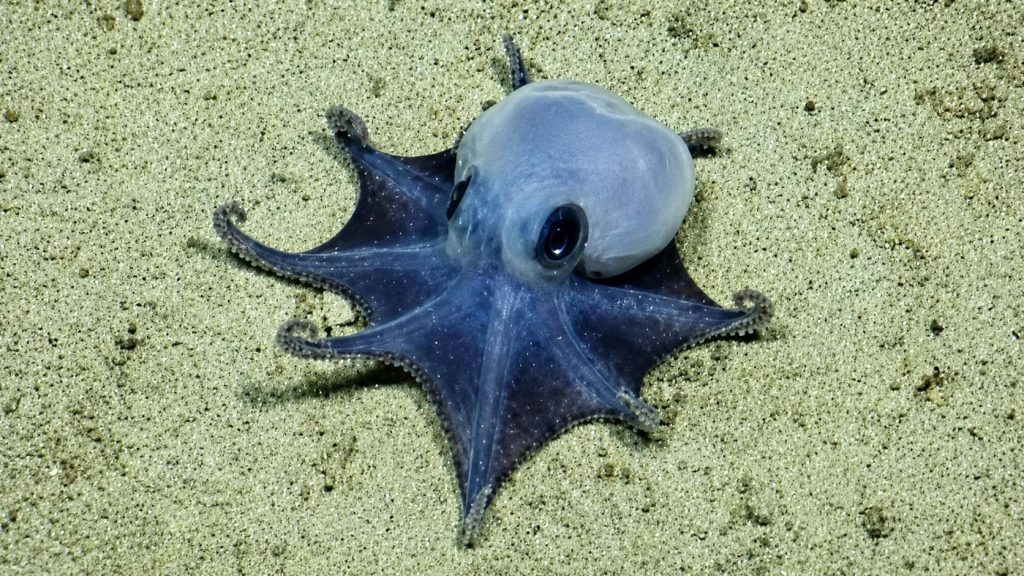
Tiny blue octopus discovered in Galapagos depths named by scientists
Translated from French and summarized by DistantNews. Read the original for the full story.
At a glance
News
Sources not specified
Context piece
- Scientists have named a miniature, electric blue octopus discovered in the deep waters of the Galapagos Islands.
- The octopus, Microeledone galapagensis, was first filmed by a deep-sea robot in 2015 at a depth of 1,773 meters.
- A virtual dissection using high-resolution medical scans allowed researchers to study its anatomy without harming the specimen, revealing unique characteristics.
Scientists have officially named a tiny, electric blue octopus discovered in the abyssal depths of the Galapagos Islands. The species, *Microeledone galapagensis*, was first captured on video by a deep-sea robot in 2015, lurking at a depth of 1,773 meters near Darwin Island.
It took eleven years, a high-resolution medical scanner, and a virtual dissection to formally identify and name the miniature cephalopod. The robot submersible Hercules, deployed from the exploration vessel E/V Nautilus, recorded the initial footage of the creature slowly moving across the seabed. During the expedition, two similar specimens were observed, and one female was collected.
Researchers faced the challenge of studying the rare deep-sea animal without damaging the sole preserved specimen. They employed computed tomography (CT) scanning, a technique that uses thousands of X-ray slices to build a detailed 3D model of the animal's internal and external structures. This virtual dissection allowed scientists to reveal its anatomy without physical intervention.
The scans revealed distinctive features: short, stout arms with a single row of suckers, unlike the double rows found on most octopuses, and smooth dorsal skin. The octopus's vibrant blue color shifts to a deep violet on its underside. The female specimen's ovaries contained thirteen eggs, confirming it was an adult. Researchers believe *Microeledone galapagensis* may be related to species found in the cold waters of Antarctica and the Pacific, representing an unexpected evolutionary branch.
I knew right away that this was something truly exceptional.
About this summary
Originally published by El Watan in French. Translated, summarized, and contextualized automatically by DistantNews, with a note on how the source frames the story. Not individually reviewed before publishing. How this works.
More Stories



From Our Blog

What Gets Lost (and Found) When News Is Translated

The Critical Role of Diaspora Media in Global News

What Travellers Should Know About Countries with Restricted Press

A Digital Nomad's Guide to Following Local News

How the Same Story Looks Different in Different Countries
