


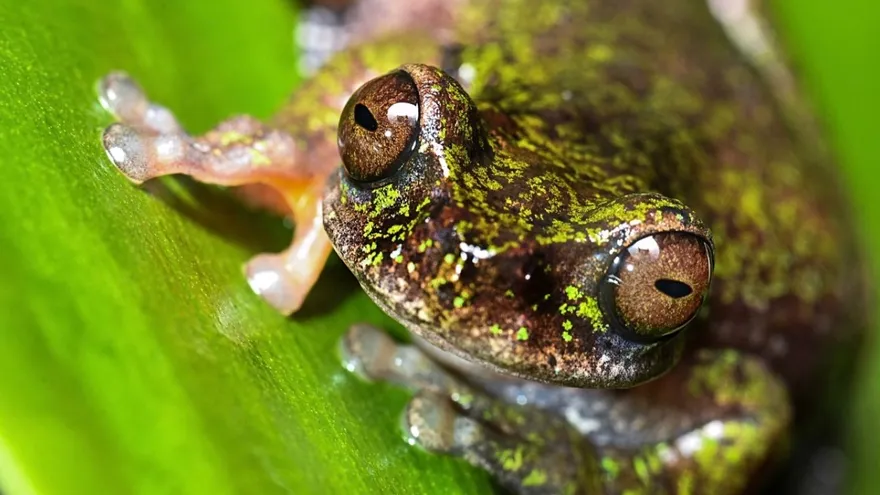
Tiny 'coffee frog,' new species, discovered in Costa Rica
Translated from Spanish, summarized and contextualized by DistantNews.
At a glance
News
From a news agency
New plan
- A new species of tiny, nocturnal tree frog, measuring less than four centimeters, has been discovered in Costa Rica's central Pacific region.
- The frog, nicknamed the "coffee frog," primarily inhabits streams along coffee plantations, finding shade, humidity, and insects there.
- Scientists warn that agrochemicals used in coffee farming pose a potential risk to the amphibian, and habitat loss due to encroachment on protected areas is another threat.
A new species of diminutive, nocturnal tree frog, measuring less than four centimeters, has been identified in Costa Rica's central Pacific region. The amphibian, distinguished by dark, irregular spots on its back and yellow-orange extremities, has found an ideal habitat in coffee plantations, earning it the nickname "coffee frog."
Scientists describe the species as new to science and endemic to Costa Rica. It is known locally as the "rana de las nacientes" due to its presence in ecosystems where rivers and streams originate. A peculiar characteristic of the males is a translucent throat sac that inflates when they emit a short, sharp call. These frogs are most active at night, often heard singing from coffee bushes.
While coffee farms offer the frogs shade, humidity, and a food source in the form of small insects, they also present potential dangers. Researchers like Wagner Chaves-Acuña warn that pesticides used to protect coffee crops could harm the amphibians, as these chemicals can travel through the air and soil, eventually reaching the water systems where tadpoles develop. Jonathan Navarro of the University of Costa Rica's International Institute for Wildlife Conservation and Management also cited habitat loss as a significant threat, particularly when protected areas are encroached upon, reducing the vegetation the frogs use for shelter and egg-laying.
Despite these risks, the discovery highlights the biodiversity within agricultural landscapes. The frog's reliance on the specific microclimate provided by coffee farms underscores the intricate relationship between agriculture and wildlife, emphasizing the need for sustainable practices to protect vulnerable species.
DistantNews Editorial
Originally published by TVN Panamá in Spanish. Translated, summarized, and contextualized by our editorial team with added local perspective. Read our editorial standards.
More Stories



From Our Blog

What Gets Lost (and Found) When News Is Translated

The Critical Role of Diaspora Media in Global News

What Travellers Should Know About Countries with Restricted Press

A Digital Nomad's Guide to Following Local News

How the Same Story Looks Different in Different Countries
