


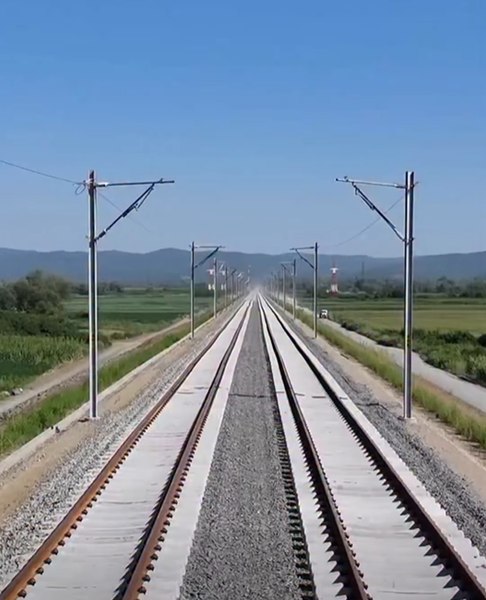
Trains return to Lugoj-Timișoara Est route after three months of work
Translated from Romanian and summarized by DistantNews. Read the original for the full story.
At a glance
News
Official statement
Ongoing story
- Rail traffic resumed on the Lugoj-Timișoara Est section on Aug. 31, 2026, after a suspension lasting nearly three months.
- The reopened route includes about 51 kilometres of newly modernized and electrified track, while the wider project has a contract value of 1.916 billion lei excluding VAT.
- Once completed, the upgraded infrastructure is expected to support passenger trains at up to 160 km/h and freight trains at up to 120 km/h.
Rail service has returned to the Lugoj-Timișoara Est route after three months of modernization work. The section reopened at 4:50 p.m. on Aug. 31, 2026.
The 54-kilometre section forms Lot 2 of the project to modernize the Caransebeș-Timișoara-Arad railway line. About 51 kilometres of newly modernized and electrified track entered service, along with roughly three kilometres of track on the old alignment near kilometre 524+013. A further three kilometres from Lot 3 helps maintain continuity through Timișoara Est station.
The design and construction contract for Lot 2 is worth 1.916 billion lei, excluding VAT. The project involves modernizing and doubling the railway infrastructure, as well as upgrades to power systems, signaling, telecommunications, bridges, culverts, stations, platforms and level crossings. It also includes the European Rail Traffic Management System, or ERTMS.
The upgraded line is intended to allow passenger trains to travel at up to 160 km/h and freight trains at up to 120 km/h, where technical conditions permit. Work continues after the reopening to complete the project. The wider modernization program aims to increase speed and capacity, improve safety and ensure interoperability with the European rail network.
About this summary
Originally published by Adevărul in Romanian. Translated, summarized, and contextualized automatically by DistantNews, with a note on how the source frames the story. Not individually reviewed before publishing. How this works.
More Stories


From Our Blog

What Gets Lost (and Found) When News Is Translated

The Critical Role of Diaspora Media in Global News

What Travellers Should Know About Countries with Restricted Press

A Digital Nomad's Guide to Following Local News

How the Same Story Looks Different in Different Countries
