

Trump talks Panama Canal with Roosevelt hologram in North Dakota
Translated from Polish, summarized and contextualized by DistantNews.
At a glance
News
Sources not specified
Context piece
- Donald Trump visited a library in North Dakota dedicated to Theodore Roosevelt, where he interacted with an AI-generated hologram of the former president.
- Trump discussed Roosevelt's achievements, including the Panama Canal, and criticized China's alleged attempts to control it.
- The article also touches on Trump's remarks about the Supreme Court's decision on birthright citizenship and his upcoming July 4th speech.
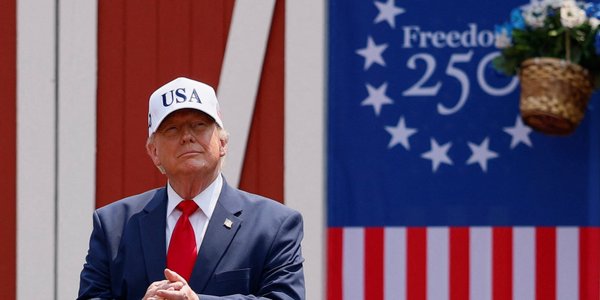
Donald Trump visited the Theodore Roosevelt Presidential Library in Medora, North Dakota, a town of 120 residents where the young Roosevelt once ran a ranch. Arriving on a new Air Force One gifted by Qatar, Trump toured the $450 million library complex, due to officially open July 4. He donated Theodore Roosevelt's Medal of Honor and pledged an additional $750,000 for the institution.
During his speech, Trump praised Roosevelt as a "man I've admired for a long time," citing the Panama Canal's construction as a major accomplishment. "And now China is trying to take over the Panama Canal, and we won't let that happen," Trump declared. He reiterated his stance on regaining U.S. control over the canal, previously suggesting military action.
And now China is trying to take over the Panama Canal, and we won't let that happen.
Trump recounted speaking with an AI-generated hologram of Roosevelt, who died in 1919. He claimed to have asked the hologram about the Panama Canal and how Roosevelt felt about "Democrats giving away the Panama Canal to Panama for one dollar," referencing Jimmy Carter's decision. Trump also linked Roosevelt's role in the Spanish-American War, which led to Cuba's independence, to current U.S. pressure on Havana, stating, "After many, many decades, Cuba is moving our way."
I spoke with the hologram of Roosevelt generated by artificial intelligence.
The president dedicated a significant portion of his address to a recent Supreme Court ruling. The court, by a 6-3 majority, upheld the constitutional guarantee of birthright citizenship (ius soli), overturning Trump's executive order that sought to limit access to citizenship based on birth in the U.S. Trump vowed to "take care of" this issue. The Justice Department had previously directed prosecutors to prioritize cases related to "birth tourism."
Looking ahead, Trump joked about his upcoming July 4th speech in Washington, D.C., despite anticipated extreme heat. "It's going to be about 107 degrees (Fahrenheit, about 42 Celsius), and I'm going to go and give a really long speech to show that I can do anything," he said. The event in Medora is connected to the upcoming 250th anniversary of the Declaration of Independence.
It's going to be about 107 degrees (Fahrenheit, about 42 Celsius), and I'm going to go and give a really long speech to show that I can do anything.
DistantNews Editorial
Originally published by Rzeczpospolita in Polish. Translated, summarized, and contextualized by our editorial team with added local perspective. Read our editorial standards.
More Stories
From Our Blog

What Gets Lost (and Found) When News Is Translated

The Critical Role of Diaspora Media in Global News

What Travellers Should Know About Countries with Restricted Press

A Digital Nomad's Guide to Following Local News

How the Same Story Looks Different in Different Countries
