


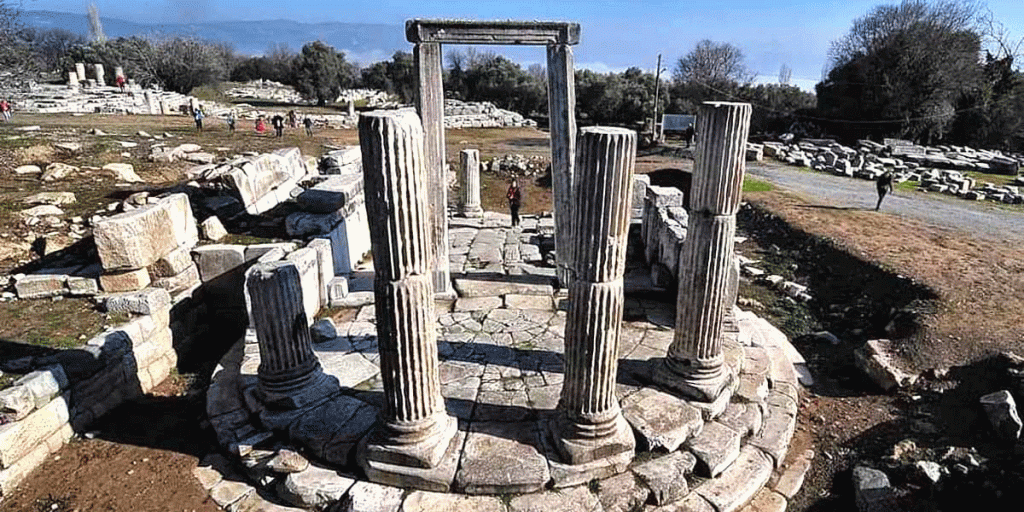
Turkey's ancient Hecate temple still draws witches and devotees
Translated from French, summarized and contextualized by DistantNews.
At a glance
In-depth
Sources not specified
Context piece
- The ancient temple of Hecate in Lagina, Turkey, continues to attract visitors interested in witchcraft and ancient pagan rites.
- Hecate, the Greek goddess associated with magic and the passage between worlds, remains a figure of veneration.
- The Lagina sanctuary is unique as the only temple of its scale built exclusively for Hecate, historically connected to the city of Stratonikeia by a Sacred Way.
Amidst the ruins of the Lagina sanctuary in Turkey's southwestern Muğla province, visitors drawn to witchcraft and ancient pagan rituals still come to pay homage to Hecate, the goddess in whose honor the site was originally erected.
This ancient site, far from being a typical tourist spot like the coastal villages of Akyaka, Marmaris, or Bodrum, draws a steady stream of visitors annually. During the late Hellenistic period and early Roman Empire, a temple was constructed here dedicated to Hecate, the powerful Greek goddess traditionally linked with magic, the moon, and the liminal spaces between worlds, including communication with the dead.
While the worship of most other Greek or Roman deities faded with antiquity, Hecate continues to be an object of veneration. Devotees from around the globe gather at the Lagina complex to leave offerings and seek her favor. The sanctuary is described as unique, not merely a building but a significant religious center dedicated to her.
Professor Bilal Söğüt, leading the excavations at Lagina and the nearby ancient city of Stratonikeia, told CNN that it is "the only temple of this scale in the world built exclusively for the goddess Hecate." Historically, Lagina and Stratonikeia were connected by an eight-kilometer-long paved Sacred Way, once lined with fountains and villages, which served as a route for important religious processions to Hecate's temple. During ancient times, large crowds from across the region would gather to commemorate her.
Researcher and author Hüma Zeybek, a specialist on Hecate, explained to CNN that a significant ritual involved a young woman, a "kleidouchos" (key-bearer), transporting a sacred object along this path. "This key does not only open physical doors. It symbolizes the ability to pass from life to death, from the conscious to the unconscious, from the old to the new," Zeybek noted. The site has endured significant political upheaval since its construction.
DistantNews Editorial
Originally published by El Watan in French. Translated, summarized, and contextualized by our editorial team with added local perspective. Read our editorial standards.
More Stories



From Our Blog

What Gets Lost (and Found) When News Is Translated

The Critical Role of Diaspora Media in Global News

What Travellers Should Know About Countries with Restricted Press

A Digital Nomad's Guide to Following Local News

How the Same Story Looks Different in Different Countries
