


U.S. praises Trinidad and Tobago's environmental deregulation after steel mill reopens
Translated from Spanish, summarized and contextualized by DistantNews.
At a glance
News
Named sources
New plan
- U.S. Deputy Secretary of State Christopher Landau praised Trinidad and Tobago's environmental deregulation following the reopening of a steel mill.
- Landau argued that excessive environmental regulations in the U.S. harmed its own industries, leading to job losses and a strategic disadvantage.
- The reopened Ibis Steel plant is expected to create 644 jobs and produce steel for U.S. military vessels and skyscrapers.
U.S. Deputy Secretary of State Christopher Landau lauded Trinidad and Tobago's relaxed environmental regulations as he attended the reopening of a disused steel mill, highlighting the move as a model for revitalizing domestic industries.
In the United States we did many terrible things in the last decades (...) Basically we destroyed our own mining industry, our own processing industry, through excessive environmental regulations, really counterproductive ones.
Speaking at the launch of the Ibis Steel plant, owned by American firm Pinnacle Steel and Vanadium Corporation, Landau stated that the United States had harmed its own industrial and mining sectors through overly burdensome environmental regulations. He contended that these rules, while intended to protect the environment, often created significant obstacles for businesses, driving industries overseas, particularly to China, and resulting in factory closures.
"Everyone wants a clean and safe environment, but at some point, layers of regulation do not really help the environment substantially, but they certainly create a nightmare for those who are trying to do business," Landau remarked. He expressed admiration for the plant's revival, likening it to Lazarus rising from the dead, and celebrated the return of jobs.
Everyone wants a clean and safe environment, but at some point, layers of regulation do not really help the environment substantially, but they certainly create a nightmare for those who are trying to do business.
The Ibis Steel plant, which had been shuttered since 2016, is projected to create 644 jobs, according to Trinidad and Tobago's Minister of Public Works and Infrastructure, Jearlean John. Landau emphasized the strategic imperative for the U.S. to revitalize such projects, noting that the plant would produce steel essential for American warships and skyscrapers. He also suggested that the U.S. had lost strategic positioning by relying on industries in other countries.
There is nothing more beautiful, frankly, than to be able to see a plant like this, which had been closed, come back to life; it is like Lazarus rising from the dead again (...) Those jobs are coming back.
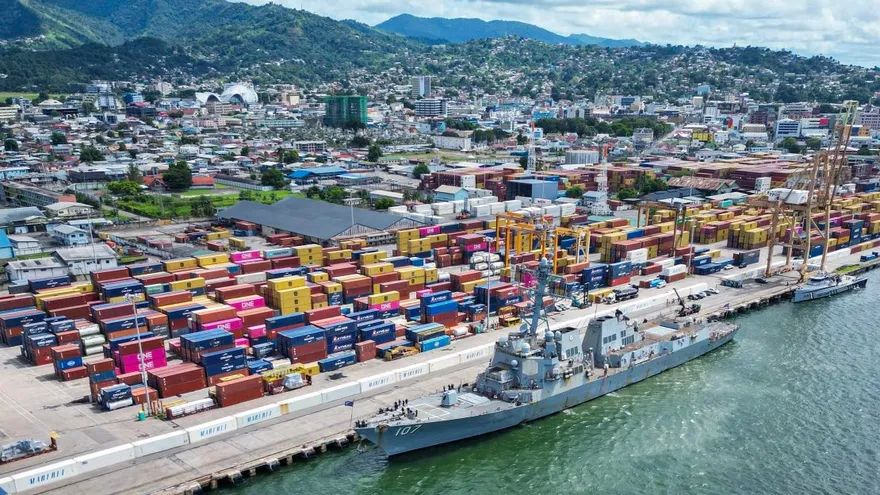
Trinidad and Tobago's Prime Minister, Kamla Persad-Bissessar, is described as an ally of Donald Trump in the region. The archipelago has recently hosted U.S. military assets, including the warship USS Gravely and a contingent of Marines, as part of a broader U.S. military deployment in the Caribbean.
It is a strategic imperative for us, as the United States, to revitalize these types of projects.
DistantNews Editorial
Originally published by TVN Panamá in Spanish. Translated, summarized, and contextualized by our editorial team with added local perspective. Read our editorial standards.
More Stories

From Our Blog

What Gets Lost (and Found) When News Is Translated

The Critical Role of Diaspora Media in Global News

What Travellers Should Know About Countries with Restricted Press

A Digital Nomad's Guide to Following Local News

How the Same Story Looks Different in Different Countries
