


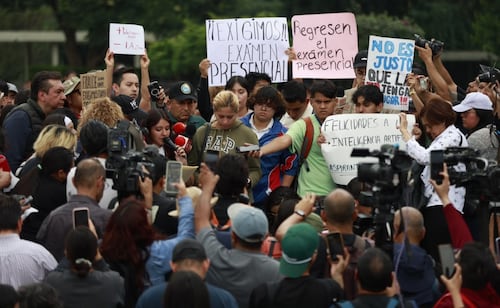
UNAM admission exam applicants report AI surveillance flaws
Translated from Spanish, summarized and contextualized by DistantNews.
At a glance
News
Named sources
Context piece
- Students who failed the National Autonomous University of Mexico's (UNAM) first online admission exam reported irregularities and insufficient AI surveillance.
- They claim the AI monitoring systems were easily bypassed using mobile devices and camera blind spots, compromising exam integrity.
- Applicants are demanding UNAM strengthen security for future virtual exams to ensure transparency and prevent suspicion.
Students who did not pass the National Autonomous University of Mexico's (UNAM) first online admission exam have come forward to detail irregularities and deficiencies they encountered. They are urging university authorities to enhance security measures for upcoming examinations, citing concerns about the effectiveness of the artificial intelligence (AI) surveillance systems employed.
These aspiring students believe the AI mechanisms used to monitor participants were inadequate, anomalous, and lax. They argue that these systems could be circumvented by simultaneously using mobile devices or by manipulating the camera's blind spots. The university had required participants to install cameras to monitor their performance, a measure intended to prevent cheating but which applicants say was easily bypassed.
Consequently, the students are demanding that UNAM reinforce its security protocols for large-scale virtual exams. They seek guarantees for the integrity and transparency of evaluation results, aiming to prevent technological suspicions from undermining the process. One applicant, Alejandro, who sought admission to Visual Design and Communication, achieved 90 out of 118 required correct answers but was still rejected.
Alejandro described facing various technological issues during the three-hour exam that were not present in practice simulations. He noted that the surveillance system frequently alerted him to look at the camera, even when he needed to focus on answering questions in subjects like mathematics or Spanish. This constant interruption caused anxiety and fear of his exam being canceled. He also found that the actual exam took longer than simulations, forcing him to rush his answers due to time constraints.
I saw the operation, for example, I wanted to solve it and the program constantly kept telling me to look at the camera, but I had to answer the exam. So I got a little worried and was afraid they would cancel my exam.
DistantNews Editorial
Originally published by El Universal in Spanish. Translated, summarized, and contextualized by our editorial team with added local perspective. Read our editorial standards.
More Stories



From Our Blog

What Press Freedom Means for the News You Read

What Gets Lost (and Found) When News Is Translated

The Critical Role of Diaspora Media in Global News

What Travellers Should Know About Countries with Restricted Press

A Digital Nomad's Guide to Following Local News
