


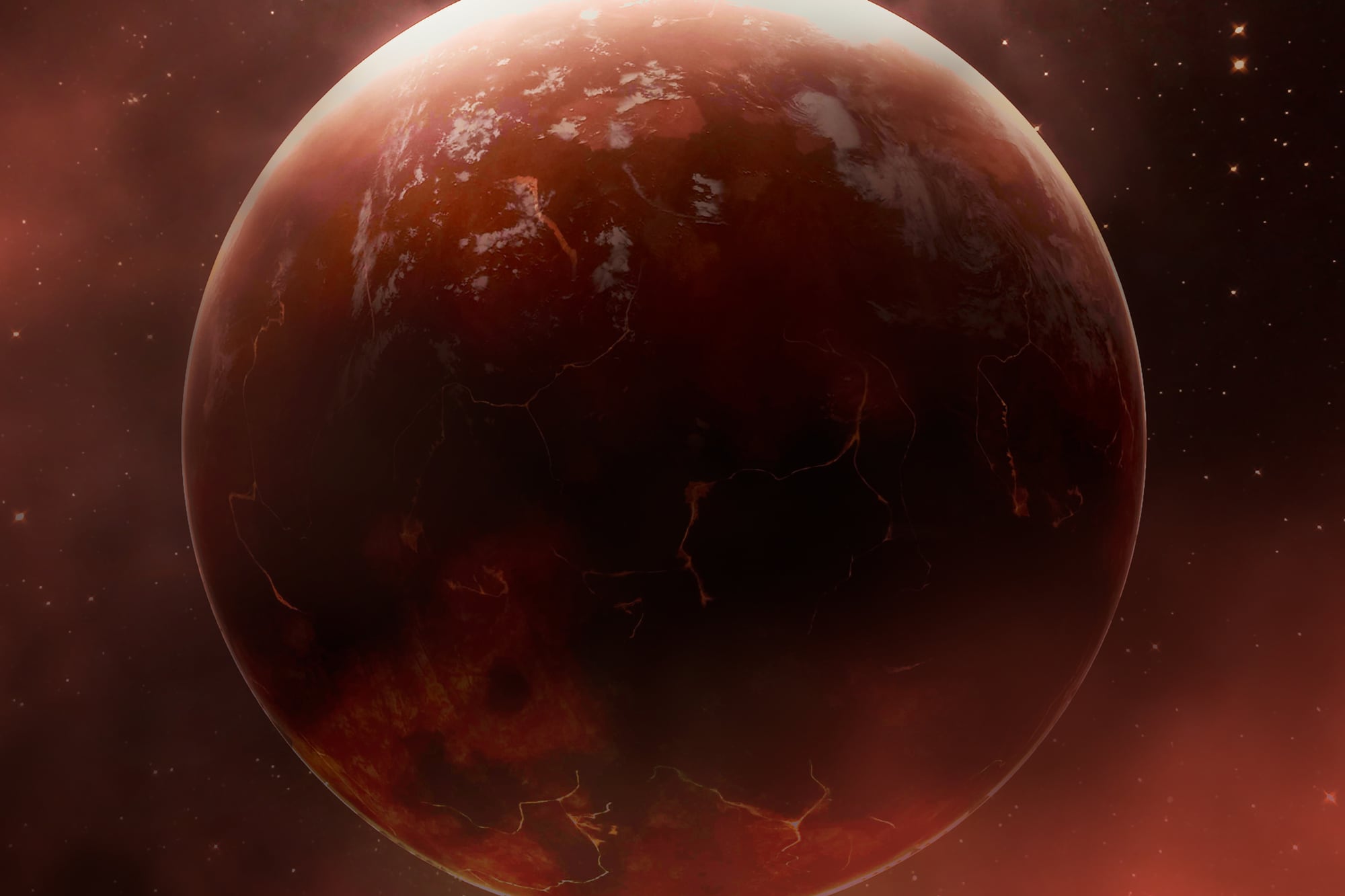
Unexpected mineral discovered in Martian meteorite offers clues to Red Planet's history
Translated from Spanish, summarized and contextualized by DistantNews.
At a glance
News
Sources not specified
Context piece
- Researchers discovered garnet grains, a mineral previously unobserved on the Red Planet, within a Martian meteorite.
- This finding provides new insights into Mars' 4.5-billion-year geological history, as garnet offers precise data on tectonic forces and formation processes.
- Scientists are investigating whether the garnet formed on Mars' surface or arrived via meteorite impact, a process that could destroy the sample.
Researchers have made an unprecedented discovery within a Martian meteorite, identifying grains of garnet, a mineral never before seen on the Red Planet. This finding opens a new window into Mars' 4.5-billion-year geological history.
On Earth, garnet is a highly valued mineral, used as a gemstone in jewelry by ancient civilizations like the Egyptians, Romans, and Victorians. Geologically, it is crucial for providing precise information about tectonic forces and formation processes that shape a planet's crust and mantle. The researchers published their findings in the journal Geochemical Perspectives Letters.
The team found the garnet grains in a tiny fragment of Martian rock, measuring just 0.8 by 0.5 millimeters. Despite its small size, the fragment acts as a geological time capsule, preserving clues about the temperatures, pressures, and processes that have affected Mars over billions of years. Tanya Kizovski, lead author of the study and a professor at Brock University, explained that garnet is a classic example of a mineral often found in metamorphic rocks on Earth, formed by extreme heat, high pressure, or hot fluids.
Garnet is a classic example of a mineral that often is found in metamorphic rocks on Earth. The process of metamorphism transforms igneous or sedimentary rocks into a new form through exposure to extreme heat, high pressure, or hot fluids.
The recovered fragments are part of the NWA 8171 meteorite, housed at the Royal Ontario Museum. The Martian garnet is an andradite variety, rich in iron and yellowish-green in color, unlike the traditional red garnet. Scientists almost overlooked the find because this hue appears in other meteorites. Kizovski noted the chemistry seemed "a little strange from the beginning." Initially thought to be pyroxene, a common mineral, the researchers decided to examine the sample more closely.
The research team is currently working to determine if the garnet formed directly on the Martian surface or arrived through an impact event. Kizovski suggests the necessary heat and pressure could have originated from a space object's impact, rising magma, or a combination of both. Confirming the origin involves studying the mineral's isotopic signatures, but this analysis risks destroying the rare sample, a risk the team has so far avoided.
The chemistry turned out to be a little strange from the beginning.
DistantNews Editorial
Originally published by La Nación in Spanish. Translated, summarized, and contextualized by our editorial team with added local perspective. Read our editorial standards.
More Stories



From Our Blog

What Gets Lost (and Found) When News Is Translated

The Critical Role of Diaspora Media in Global News

What Travellers Should Know About Countries with Restricted Press

A Digital Nomad's Guide to Following Local News

How the Same Story Looks Different in Different Countries
