


US issues de facto ultimatum to Iran over ship attacks
Translated from Korean, summarized and contextualized by DistantNews.
At a glance
News
Named sources
Ongoing story
- The U.S. has issued an ultimatum to Iran, demanding a public statement by Nov. 11 to cease attacks on commercial vessels.
- Failure to comply could result in severe consequences, including military action.
- Upcoming talks between Iran and Oman are seen as a critical juncture in potential U.S.-Iran conflict.
The United States has delivered what amounts to an ultimatum to Iran, demanding a public statement by November 11 that it will halt attacks on commercial vessels in the Strait of Hormuz and ensure free passage through all shipping lanes. U.S. officials warned that failure to comply could lead to "harsh consequences," potentially including military responses.
This demand comes as U.S.-Iran diplomatic talks are set to take place in Oman on November 11. These discussions are viewed as a crucial turning point that could either de-escalate tensions or lead to a significant confrontation. U.S. officials expressed that recent dialogue with Iran has been unproductive, criticizing Tehran for not adhering to a memorandum of understanding signed last month.
What we are asking for is for Iran to issue a public statement acknowledging that all shipping lanes in the Strait of Hormuz are open and that they will no longer fire on vessels. If they do not issue that statement, there will not be a good outcome.
"What we are asking for is for Iran to issue a public statement acknowledging that all shipping lanes in the Strait of Hormuz are open and that they will no longer fire on vessels," one official stated, adding that "if they do not issue that statement, there will not be a good outcome." Another official warned, "We will attack them again" if commercial vessel attacks continue. The U.S. has assigned Iran a "F grade" for its compliance with agreements, according to Axios.
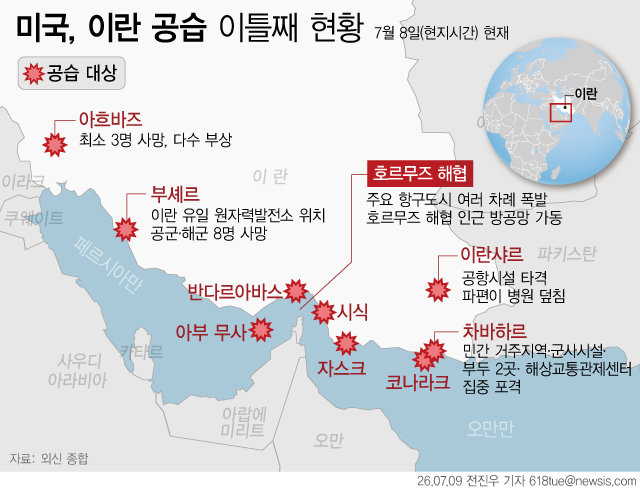
Recent weeks have seen three commercial vessels linked to Qatar and Saudi Arabia attacked in the Strait of Hormuz. In response, the U.S. conducted airstrikes on Iranian coastal defense systems, missile and drone facilities, and naval and logistics infrastructure. Iran, in turn, launched missiles and drones targeting U.S. facilities and allies in the Gulf region. U.S. President Donald Trump declared a recent ceasefire "over" but indicated a willingness to continue negotiations with Iran.
We will attack them again.
U.S. officials believe that if Iran cannot uphold the basic promise of ceasing vessel attacks, its ability and willingness to implement a more complex nuclear deal would be questionable. "If Iran cannot keep the easiest promise, not to fire on vessels, we cannot move on to the nuclear negotiations," an official said. The U.S. perceives an internal power struggle within Iran between hardliners and pragmatists regarding the implementation of the MOU and negotiations with the U.S.
If Iran cannot keep the easiest promise, not to fire on vessels, we cannot move on to the nuclear negotiations.
Iranian officials have denied claims that Iran requested negotiations with the U.S. Meanwhile, President Trump has reportedly instructed his negotiation team, including Vice President Mike Pence, Secretary of State Mike Pompeo, envoy Steve Witkoff, and son-in-law Jared Kushner, to continue talks. However, an official cautioned that while the team has been given "space and time" to reach an agreement, it is "not a lot of space and time," and broad alternatives are being prepared in case negotiations fail.
In parallel, the U.S. Treasury Department sanctioned 14 individuals and entities, including Dubai-based Iranian financier Ali Ansary, exchange offices, and shell companies. The Treasury stated that Ansary has been funneling public funds to Mojtaba Khamenei, the Supreme Leader's son, regime elites, and the Revolutionary Guard.
We have given the negotiation team space and time to reach an agreement, but not a lot of space and time.
DistantNews Editorial
Originally published by Hankyoreh in Korean. Translated, summarized, and contextualized by our editorial team with added local perspective. Read our editorial standards.
More Stories


From Our Blog

What Gets Lost (and Found) When News Is Translated

The Critical Role of Diaspora Media in Global News

What Travellers Should Know About Countries with Restricted Press

A Digital Nomad's Guide to Following Local News

How the Same Story Looks Different in Different Countries
