


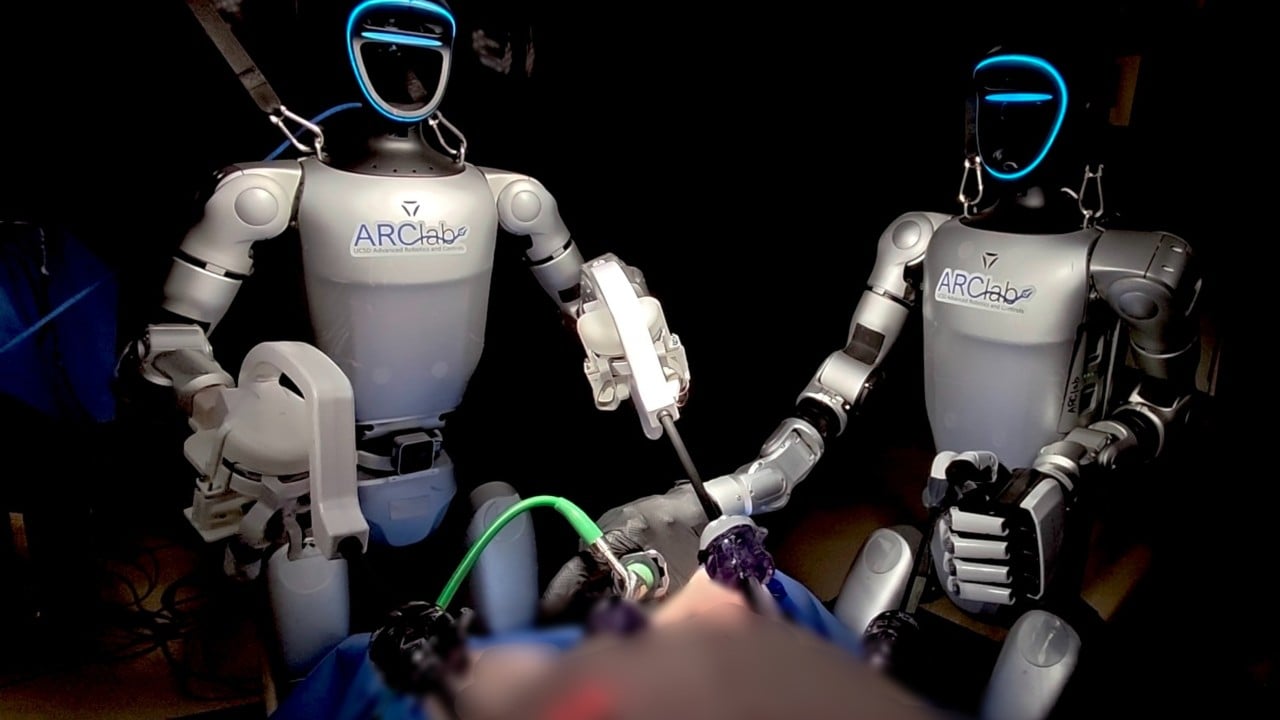
US scientists use Chinese humanoid robot to carry out keyhole surgery and remove organs
Summarized and contextualized by DistantNews.
At a glance
News
Sources not specified
Outcome reported
- U.S. scientists remotely operated a Chinese-made humanoid robot to perform keyhole surgery and remove a pig's gallbladder.
- The robot, developed by Unitree Robotics, was controlled by two human surgeons at the University of California San Diego (UCSD).
- Researchers believe this technology has significant potential to expand access to critical surgeries globally, addressing healthcare crises.
Scientists in the United States have successfully utilized a Chinese-made humanoid robot to perform keyhole surgery, marking a significant advancement in robotic-assisted medical procedures. The general-purpose robot, developed by Unitree Robotics, remotely executed the removal of a pig's gallbladder at the University of California San Diego (UCSD).
Two human surgeons guided the robot during the operation. In a supporting role, another robot managed the endoscope, providing visualization of the surgical site, and assisted with tissue retraction. This human-robot collaboration demonstrates the potential for advanced technology to augment surgical capabilities.
Remotely operated and autonomous humanoid robots have real potential for expanding access to critical surgeries that patients might otherwise go without.
Michael Yip, a professor in UCSD's Department of Electrical and Computer Engineering and senior author of the study, highlighted the potential impact of this technology. He stated that remotely operated and autonomous humanoid robots could significantly expand access to critical surgeries for patients who might otherwise be unable to receive them.
Yip further suggested that this innovation could help address healthcare crises not only within the United States but on a worldwide scale. The successful procedure underscores the growing integration of robotics in complex medical interventions and opens new avenues for improving surgical outcomes and accessibility.
This could help address healthcare crises not only in the US, but worldwide.
DistantNews Editorial
Originally published by South China Morning Post. Summarized and contextualized by our editorial team with added local perspective. Read our editorial standards.
More Stories


From Our Blog

Countries Without a Free Press: What You Need to Know

What Press Freedom Means for the News You Read

What Gets Lost (and Found) When News Is Translated

The Critical Role of Diaspora Media in Global News

What Travellers Should Know About Countries with Restricted Press
