


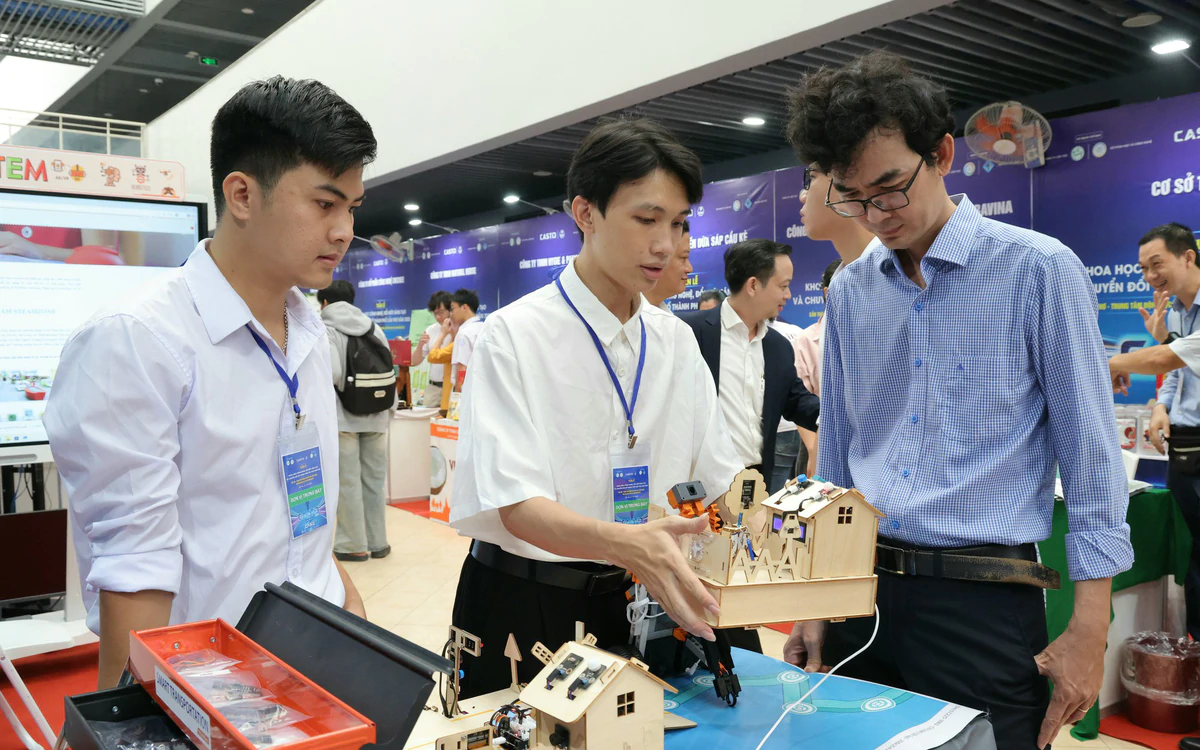

Vietnam National University Ho Chi Minh City sets aside 1.875 trillion dong for AI, chips and robotics
Translated from Vietnamese and summarized by DistantNews. Read the original for the full story.
At a glance
News
Documents & data
New plan
- Vietnam National University Ho Chi Minh City plans to spend 1.875 trillion dong on strategic technology research and development.
- Its roadmap covers 10 groups, including AI and data, semiconductors, robotics, aerospace, biotechnology, healthcare, advanced materials, energy, quantum technology and high-speed rail.
- The university plans 63 digital technology and AI projects in 2026, with that number expected to rise to 72 in 2027.
Vietnam National University Ho Chi Minh City is committing 1.875 trillion dong to a race for strategic technologies, with artificial intelligence, semiconductor chips, robotics and quantum technology among its leading priorities.
The university’s roadmap runs through 2030 and beyond. It covers 10 technology groups: digital technology, AI and data; semiconductor chips and integrated circuits; robotics and automation; aviation, space and the low-altitude economy; biotechnology; biomedicine and healthcare; advanced materials; energy and the environment; quantum technology; and high-speed and urban rail.
In AI and data, early work will focus on healthcare, education, public administration, big data and traceability. By 2030, the university aims to develop multimodal AI, Vietnamese large language models, digital twins and AI for smart manufacturing, with a longer-term goal of sovereign AI and a national data ecosystem.
Semiconductor research will include shared infrastructure, Edge AI chips, chips for the Internet of Things and unmanned aerial vehicles, and very-high-frequency signals. The roadmap then moves toward RISC-V, photonic chips, radar, electronic warfare and advanced packaging, before targeting high-performance chips, 6G and aerospace applications.
Robotics research will begin with service robots and collaborative robots, then expand to industrial robots and autonomous systems. Aerospace work will cover UAVs, GPS-free positioning, flight control, radar and chips, followed by Earth observation, environmental monitoring and satellite technology. Biotechnology priorities include microorganisms, enzymes and biological products, later expanding to synthetic biology, cell technology, vaccines, gene editing and new medicines. Biomedical research will include molecular diagnostics and AI-assisted diagnosis, followed by organoids, 3D bioprinting, regenerative medicine and precision medicine.
The university expects the program to generate a substantial research portfolio. In 2026, it plans 63 projects in digital technology and AI, 54 in biology and microbiology, 50 in energy and materials, 10 in robotics and automation, eight in semiconductor chips, and eight in cybersecurity and quantum technology. The number of digital technology and AI projects is expected to rise to 72 in 2027. Approved programs already include AI in healthcare and public administration, as well as biotechnology research.
About this summary
Originally published by Tuổi Trẻ in Vietnamese. Translated, summarized, and contextualized automatically by DistantNews, with a note on how the source frames the story. Not individually reviewed before publishing. How this works.
More Stories


From Our Blog

News in Translation: What Gets Lost, and How We Keep the Framing

Diaspora Media: How Communities Follow News From Home

Traveling Where the Press Is Not Free: How to Read the News There

The Digital Nomad's Guide to Local News

The Same Story, Different Countries: How Coverage Changes at the Border
