


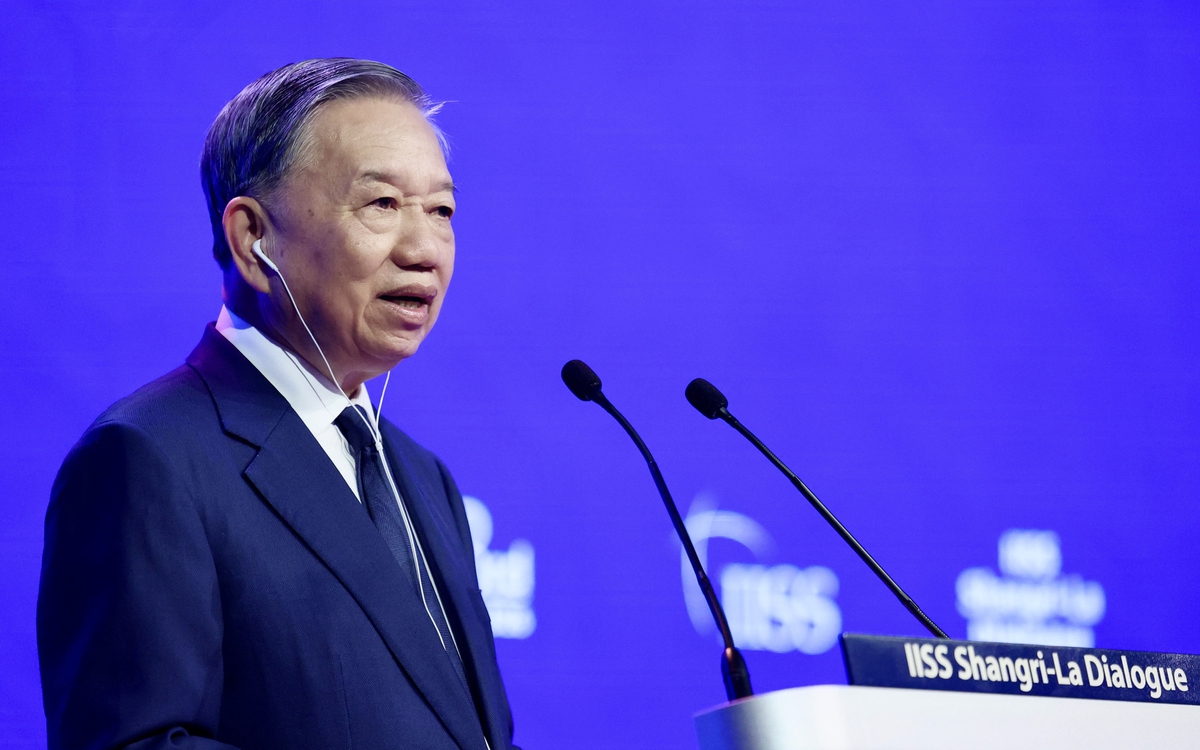
Vietnam's position viewed from the Shangri-La Dialogue
Translated from Vietnamese and summarized by DistantNews. Read the original for the full story.
At a glance
Analysis
Named sources
New plan
- Vietnamese President To Lam addressed the Shangri-La Dialogue in Singapore, emphasizing proactive peacebuilding.
- He highlighted three core crises: international order, development models, and strategic trust, particularly in the Asia-Pacific.
- Lam proposed solutions including strengthening the rule of law, dialogue, an open and ASEAN-centric regional structure, and prioritizing human security.
Vietnamese President To Lam presented a confident and proactive vision for Vietnam's role in shaping the international agenda at the 23rd Shangri-La Dialogue in Singapore. His keynote address, themed "Proactively Building Peace - Stability - Development in a Turbulent World," underscored that peace cannot be passively awaited but must be actively constructed.
Peace, stability, and development are the common denominators of all nations and peoples.
Lam articulated that stability relies not on deterrence alone but on nurturing through law, dialogue, self-restraint, and trust. Development, he argued, is inseparable from security and forms its foundation. He identified three fundamental crises of the era: the crisis of international order, the crisis of development models, and the crisis of strategic trust, which he described as a "silent but dangerous crisis" fostering suspicion and unease among nations.
Peace cannot be passively waited for but must be proactively built; stability cannot rely solely on deterrence but must be nurtured by law, dialogue, self-restraint, and trust; and development cannot stand outside of security, but on the contrary, must be the foundation for sustainable security.
These crises, Lam noted, are converging in the Asia-Pacific, a dynamic economic hub also marked by intense strategic competition. "Precisely because it is a convergence of challenges, Asia-Pacific must also be the place where solutions originate," he asserted. To foster a peaceful, stable, developed, and self-reliant Asia-Pacific, Vietnam's leader proposed several key initiatives.
the crisis of strategic trust is a silent but dangerous crisis, because it makes nations easily view each other's actions through a lens of suspicion and unease.
First, he called for making law and dialogue effective tools for mitigating risks, especially concerning seas and oceans, warning that "no country benefits if these connection routes become arenas for power projection, coercion, or confrontation." Second, he advocated for an open, inclusive, and ASEAN-centric regional structure. Third, he stressed the importance of placing human security and societal resilience at the core of sustainable security. Fourth, Lam proposed establishing responsible norms for new technologies and defense industries, promoting dialogue on AI in defense and security, and ensuring human accountability in critical decisions. Finally, he emphasized strengthening social foundations, enhancing information space security, and raising awareness, asserting that a society capable of discerning right from wrong and maintaining consensus is crucial.
Precisely because it is a convergence of challenges, Asia-Pacific must also be the place where solutions originate.
About this summary
Originally published by Tuổi Trẻ in Vietnamese. Translated, summarized, and contextualized automatically by DistantNews, with a note on how the source frames the story. Not individually reviewed before publishing. How this works.
More Stories
From Our Blog

What Gets Lost (and Found) When News Is Translated

The Critical Role of Diaspora Media in Global News

What Travellers Should Know About Countries with Restricted Press

A Digital Nomad's Guide to Following Local News

How the Same Story Looks Different in Different Countries
