


Vietnamese Police Officer Keeps Ancient Jrai Gong Music Alive
Translated from Vietnamese, summarized and contextualized by DistantNews.
At a glance
In-depth
Named sources
Context piece
- Police officer Ksor Vui dedicates his free time to teaching traditional Jrai ethnic group's gong music to young people in Gia Lai province, Vietnam.
- Vui, who has served as a police officer for over 10 years, learned the traditional music from his grandfather and now leads classes four evenings a week.
- He aims to preserve the cultural heritage of the Jrai people by passing down the ancient gong traditions to the younger generation.
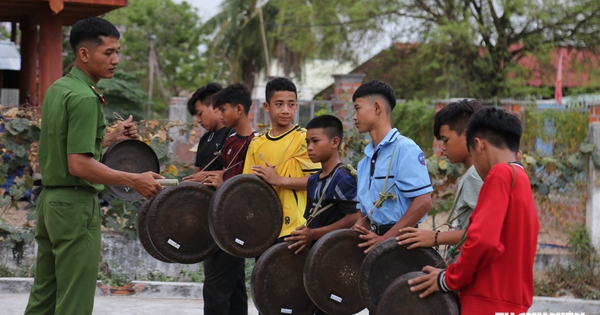
In the village of Phu Ama Nher 2, Gia Lai province, Vietnam, the sound of ancient Jrai gongs resonates through the night, led not by an elder or cultural official, but by Police Lieutenant Ksor Vui. For over three years, Vui has devoted four evenings each week, after fulfilling his duties securing public order, to becoming a torchbearer for the younger generation, teaching them the traditional Jrai gong music.
Now 30, Lieutenant Vui has worn the police uniform for more than a decade. Originally from Ayun Pa town, he moved to his wife's village in Phu Ama Nher 2 after marriage, following Jrai custom. Few realize that alongside his responsibilities as a police officer, he harbors a deep passion for the cultural heritage of the Central Highlands' gong traditions.
Vui's love for the gongs was nurtured from childhood. His grandfather was a renowned gong player in the region, leading gong troupes during festivals. Priceless gong sets, once exchanged for livestock, remain in his family. Growing up surrounded by this music, young Ksor Vui would quietly listen, imitate the rhythms, and follow the troupes to learn from other villages.
The passion for gongs just seeped into me without me realizing it.
He explains that the Ayun Pa region is known for the Kơ Đơ (T'nah Ring) gong set, comprising two gongs and six smaller chimes, traditionally used in festivals like the new rice celebration, weddings, or housewarmings. In the past, these gongs, along with drums, served as a communication method between villages before modern technology like telephones and radios existed, with each rhythm carrying a unique message, similar to ancient communities worldwide using drums for connection.
Vui's current concern is not just the declining number of people who can play the gongs, but the lack of access for young people to learn these ancient instruments. This motivated him to start classes. Initially attracting a few curious children, the groups have since grown significantly. The male gong troupe in Ia Sao village now has about 20 members, and Vui recently established a female troupe in Ayun Pa town with a similar number, ranging in age from 7 to 25. All instruction is free, with lessons relying solely on the sound of the gongs, the teacher's hands, and his patience, rather than formal blackboards or lesson plans. The students also learn to play the Tha gong set, also known as the ancient Arap gong, which includes six large gongs and nine smaller, unadorned chimes.
In the past, the sound of gongs and drums was also a means of transmitting information between villages when roads were difficult and there were no telephones or loudspeakers. Each gong rhythm carries its own message, just like how many ancient communities around the world used drums to connect with each other.
DistantNews Editorial
Originally published by Thanh Niên in Vietnamese. Translated, summarized, and contextualized by our editorial team with added local perspective. Read our editorial standards.
More Stories


From Our Blog

What Gets Lost (and Found) When News Is Translated

The Critical Role of Diaspora Media in Global News

What Travellers Should Know About Countries with Restricted Press

A Digital Nomad's Guide to Following Local News

How the Same Story Looks Different in Different Countries
