

Why Mount Etna Erupts in Japan and How Many Richter Scales a Human Construction Can Withstand
Translated from Greek, summarized and contextualized by DistantNews.
At a glance
News
Sources not specified
Ongoing story
- - A powerful earthquake in southern Japan highlights the country's location on a highly active geological fault line.
- Despite advanced technology and strict building codes, nature's power remains a significant threat.
- Modern skyscrapers are designed to withstand seismic activity, but extreme events like the 2011 Tohoku earthquake (9.0 magnitude) test the limits of even advanced infrastructure.
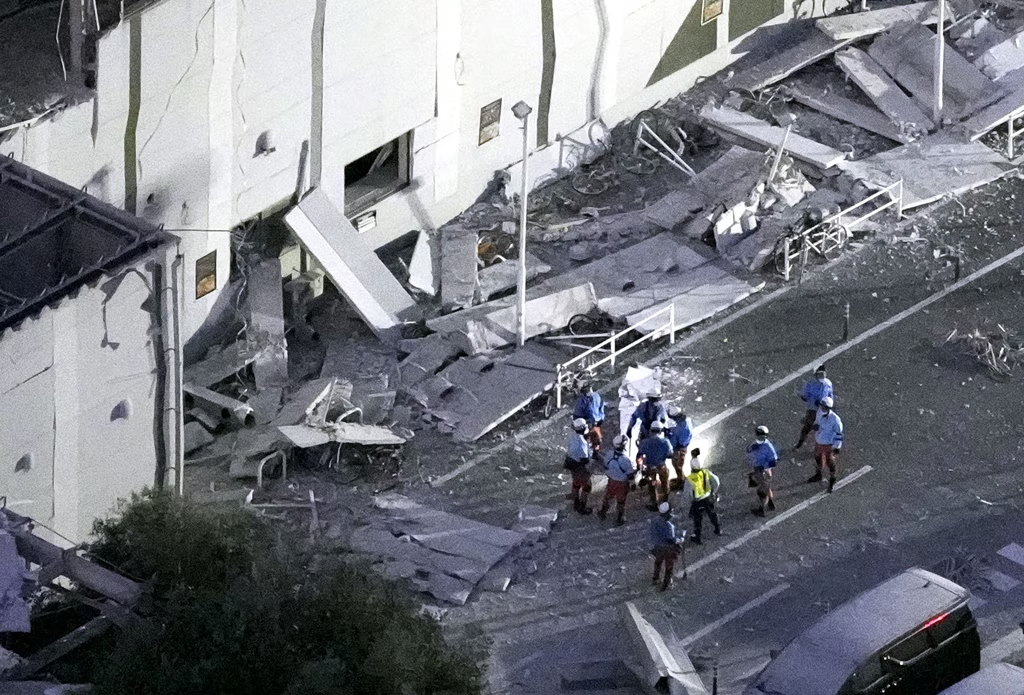
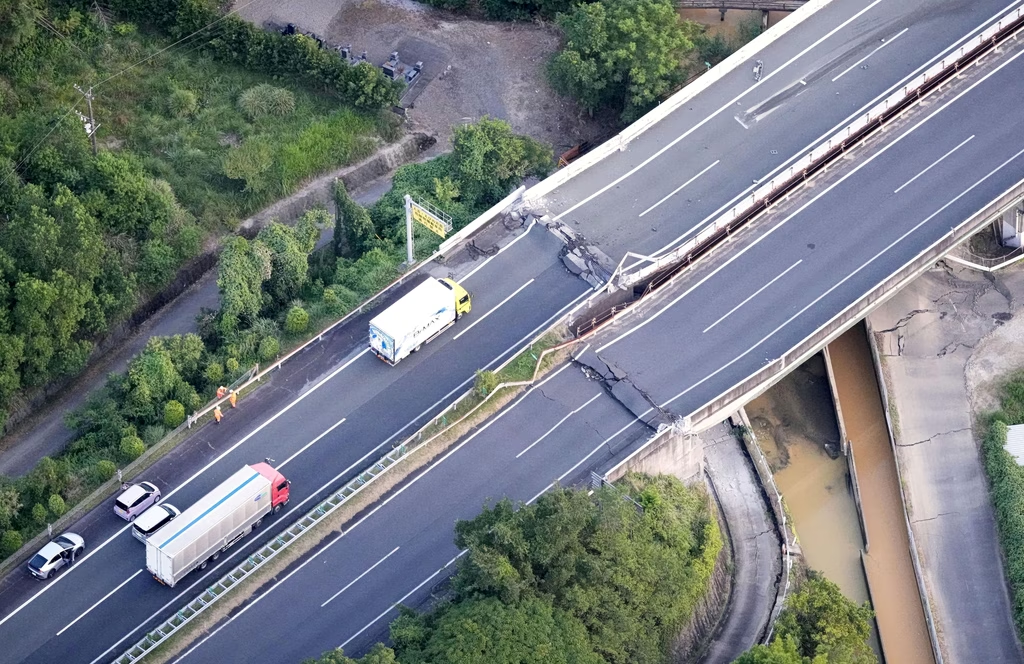
A strong earthquake in southern Japan has once again brought to the forefront the reality that the nation resides on one of the planet's most geologically volatile regions. Even with impressive anti-seismic technology, the world's strictest building standards, and sophisticated early warning systems, nature consistently reminds Japan that while the consequences of earthquakes can be mitigated, they cannot be entirely defeated.
Japan sits at a convergence point of four major tectonic plates: the Pacific Plate, the Philippine Sea Plate, the Eurasian Plate, and the North American Plate (or the Okhotsk microplate, according to some models). The constant movement of these plates generates immense pressure within the Earth's crust. This pressure builds over decades or centuries before releasing in seconds as a catastrophic earthquake. Denser oceanic plates subduct slowly beneath others, creating vast fault zones deep within the crust. These zones can remain locked for years, storing enormous energy until they rupture abruptly, triggering some of the planet's largest earthquakes, often accompanied by devastating tsunamis.
It is no coincidence that Japan lies along the Pacific Ring of Fire, a roughly 40,000-kilometer zone encircling the Pacific Ocean. This region hosts about 75% of the Earth's active volcanoes and nearly 90% of global seismic activity. Japan experiences over 1,500 perceptible earthquakes annually, with thousands more too small to be felt by humans but detectable by seismographs. The recent earthquake serves as another stark reminder that regardless of technological advancement, the sheer power of natural phenomena can overwhelm human constructions.
Modern Japanese skyscrapers are engineered to flex rather than collapse, built on specialized shock absorbers, and equipped with mechanisms to significantly reduce oscillations. However, when an earthquake reaches or exceeds magnitude 8, the forces involved are so immense that even the most advanced infrastructure is tested to its limits. This was dramatically demonstrated on March 11, 2011, when a magnitude 9.0 earthquake off the coast of Tohoku became the strongest ever recorded in Japan's history. The subsequent tsunami, reaching heights of up to 40 meters in some areas, caused over 18,000 deaths and disappearances, and led to the most severe nuclear crisis since Chernobyl at the Fukushima plant. Earlier, in 1923, the Great Kanto earthquake, estimated at magnitude 7.9 to 8.2, devastated Tokyo and Yokohama, with ensuing fires causing even greater destruction.
DistantNews Editorial
Originally published by Ta Nea in Greek. Translated, summarized, and contextualized by our editorial team with added local perspective. Read our editorial standards.
More Stories
From Our Blog

What Gets Lost (and Found) When News Is Translated

The Critical Role of Diaspora Media in Global News

What Travellers Should Know About Countries with Restricted Press

A Digital Nomad's Guide to Following Local News

How the Same Story Looks Different in Different Countries
