


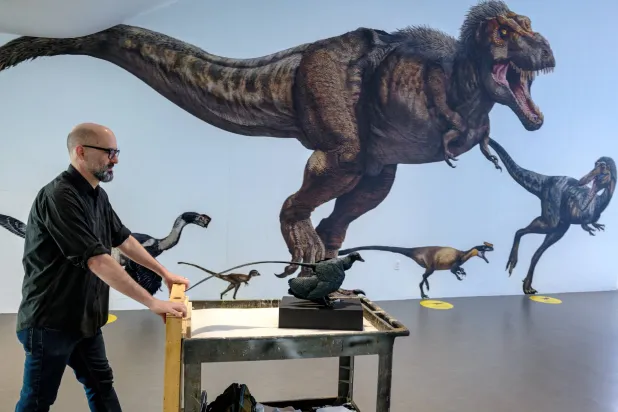
Why Were There No Tiny Dinosaurs? Mammals May Be to Blame
Translated from English, summarized and contextualized by DistantNews.
At a glance
News
Sources not specified
Context piece
- Scientists have long debated why no exceptionally small dinosaur species have been found.
- New research suggests that early mammals may have preyed on dinosaur eggs and hatchlings, preventing small species from thriving.
- This theory offers a potential explanation for the evolutionary gap in dinosaur sizes.
The fossil record presents a curious puzzle: the absence of exceptionally tiny dinosaurs. While paleontologists have unearthed a vast array of dinosaur species, ranging from the colossal to the moderately sized, the smallest known dinosaurs were still quite substantial compared to many modern animals. Now, new research proposes a compelling explanation for this evolutionary gap, pointing fingers at our own ancient ancestors: mammals.
The prevailing theory suggests that early mammals, driven by their own survival needs, may have actively suppressed the proliferation of small dinosaur species. These opportunistic mammals likely preyed on dinosaur eggs and newly hatched young. By consistently targeting the smallest and most vulnerable dinosaurs, mammals could have effectively prevented these smaller lineages from establishing themselves and diversifying. This ecological pressure would have favored larger dinosaur species that were less susceptible to mammalian predation.
DistantNews Editorial
Originally published by Asharq Al-Awsat in English. Translated, summarized, and contextualized by our editorial team with added local perspective. Read our editorial standards.
More Stories


From Our Blog

What Gets Lost (and Found) When News Is Translated

The Critical Role of Diaspora Media in Global News

What Travellers Should Know About Countries with Restricted Press

A Digital Nomad's Guide to Following Local News

How the Same Story Looks Different in Different Countries
