

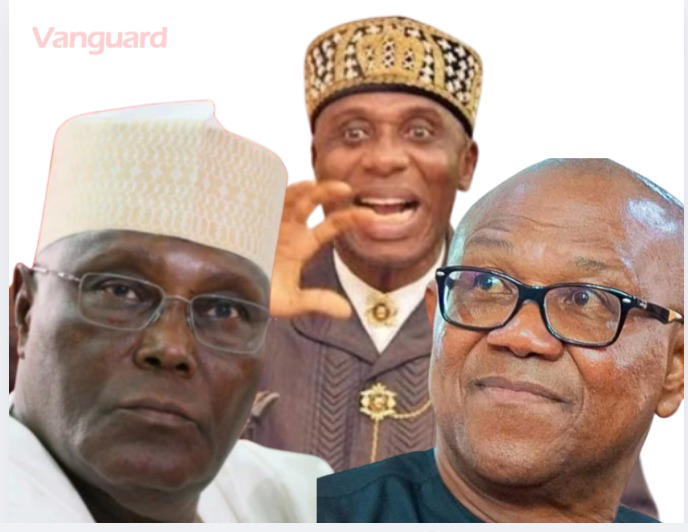

Will PDP Survive Nyesom Wike?
Summarized and contextualized by DistantNews.
TLDR
- The Peoples Democratic Party (PDP) in Nigeria is described as a shadow of its former self, facing internal struggles and a potential decline.
- Former President Olusegun Obasanjo is credited with building the party on
The Peoples Democratic Party (PDP) is in a dire state, a self-inflicted wound that has reduced it to a mere shadow of its once-dominant self. This narrative, as presented by Mobolaji Sanusi, serves as a stark lesson for Nigeria's current ruling party and indeed, all political entities. The party's downfall is intricately linked to its past, with former President Olusegun Obasanjo's role in establishing its 'crooked democratic values' and Nyesom Wike's current efforts to dismantle it from within highlighted.
Wike, now the Minister of the Federal Capital Territory (FCT) and former governor of Rivers State, has been particularly instrumental in the PDP's decline. His recent visit to the PDP headquarters saw him make statements that exposed a perceived underestimation of the public's political awareness. While claiming to still be part of the PDP, he acknowledged the party's current status as the main opposition, yet pointedly questioned the credentials of those leading it, stating they had never won an election, not even for a local councilor. This critique, while factually highlighting electoral failures, comes from a figure widely seen as having personally weakened the party he claims allegiance to.
Those who don’t know the truth are fools, but those who know the truth and call it a lie are criminals.
From a Nigerian perspective, the PDP's internal strife is a recurring theme. The Yoruba saying, “Ehinkule’lota’wa…inu’ile’ni’aseni’ngbe…,” which translates to 'our enemies are outside our compound, but our true downfall comes from within,' perfectly encapsulates the party's perpetual battle against itself. While the article laments the potential 'ineffectual extinction' of the PDP and other parties, emphasizing their role in the nation's democratic evolution, it doesn't shy away from the harsh reality of their internal decay. The piece implicitly criticizes the public's tendency to defend individuals they favor, especially if there are financial benefits, rather than defending what is right. This reflects a common observation in Nigerian political discourse, where loyalty is often transactional rather than ideological.
What makes this story uniquely interesting from a Nigerian viewpoint is the deep-seated understanding of political party dynamics and the cyclical nature of power. The article doesn't just report on a party's struggles; it delves into the historical context and the personalities driving its current predicament. Unlike Western media, which might focus solely on the electoral implications, Nigerian coverage often dissects the internal machinations, the betrayals, and the personality clashes that define political landscapes. The PDP's current state is not just a news item; it's a reflection of broader issues within Nigeria's political culture, where personal ambition and internal wrangling frequently overshadow party ideology and national interest. The author's use of a Brecht quote at the beginning sets a somber, critical tone, suggesting a deep disappointment with the current state of affairs and a call for accountability.
Today we are not in government, but this is the main opposition party as far as this country is concerned. You cannot become a main opposition party without winning elections. So those who say that they are leading the opposition have never contested in any election. The one they contested is the Abuja Municipal Area Council; they could not get one councillor.
DistantNews Editorial
Originally published by ThisDay. Summarized and contextualized by our editorial team with added local perspective. Read our editorial standards.
More Stories


From Our Blog

How the Same Story Looks Different in Different Countries

What Gets Lost (and Found) When News Is Translated

The Critical Role of Diaspora Media in Global News

What Travellers Should Know About Countries with Restricted Press

A Digital Nomad's Guide to Following Local News
