


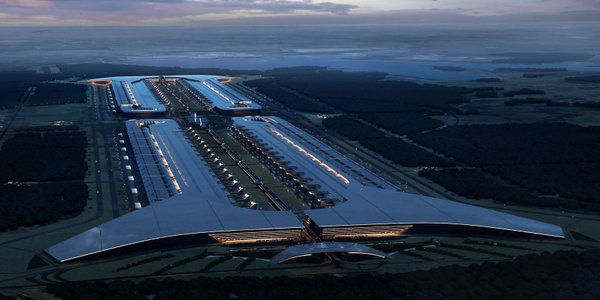
World's largest building to rise: Musk plans to break China's record with Texas chip factory
Translated from Polish, summarized and contextualized by DistantNews.
At a glance
News
Sources not specified
New plan
- Elon Musk's companies Tesla and SpaceX plan to build a massive semiconductor factory, Terafab, in Grimes County, Texas.
- The first phase of the project is estimated to cost $16.8 billion, with the entire complex potentially covering 9.3 million square meters.
- If built to scale, Terafab could become the largest building on Earth, significantly surpassing China's New Century Global Center.
Elon Musk's ventures, Tesla and SpaceX, are planning to construct a colossal semiconductor factory named Terafab in Grimes County, Texas. This ambitious project, located in the Brazos Valley region, is set to become one of the largest buildings globally if realized to its full declared scale. The initial phase of this investment is projected to cost $16.8 billion, with the complete complex slated to span approximately 9.3 million square meters.
definitely the largest and most valuable building on Earth.
Musk himself has described the planned facility as "definitely the largest and most valuable building on Earth." Should it reach its intended size, Terafab would dwarf the current record holder, the New Century Global Center in Chengdu, China, which measures around 1.75 million square meters. It would also significantly outsize major structures like the Pentagon, Apple Park, and the Mall of America.
The ultimate title of the world's largest building hinges on the final construction details and the measurement criteria used. The reported 9.3 million square meters encompasses the entire planned complex, and the exact proportion dedicated to actual production space remains to be seen. Visualizations depict a sprawling, wing-shaped structure with a semi-transparent roof, which Musk promises will be as impressive as it is gigantic, aiming for a "sci-fi city" aesthetic.
The structure will be stunningly beautiful.
This venture is driven by a strategic need for self-sufficiency in chip supply. Both Tesla and SpaceX anticipate a demand for integrated circuits far exceeding current and future global production capacities, aiming to produce over 1 terawatt of computing power annually. The facility is designed for a full production process, including logic and memory chip manufacturing, packaging, and testing, aiming to bridge the gap between current supply and future computational needs.
We are aiming for a sci-fi city.
By establishing Terafab, Musk's companies intend to reduce their reliance on external chip manufacturers, particularly Asian giants like TSMC and Samsung. While Tesla and SpaceX have designed their own chips, they have outsourced production. In an era of geopolitical tensions surrounding Taiwan and persistent shortages in AI chip manufacturing capacity, creating an integrated, in-house supply chain is seen as a critical move for greater security. SpaceX is collaborating with Intel to assist in launching production, indicating a strategic partnership to bring this massive project to fruition.
Both Tesla and SpaceX will need significantly more chips than current and future global production can supply.
DistantNews Editorial
Originally published by Rzeczpospolita in Polish. Translated, summarized, and contextualized by our editorial team with added local perspective. Read our editorial standards.
More Stories

From Our Blog

What Gets Lost (and Found) When News Is Translated

The Critical Role of Diaspora Media in Global News

What Travellers Should Know About Countries with Restricted Press

A Digital Nomad's Guide to Following Local News

How the Same Story Looks Different in Different Countries
