


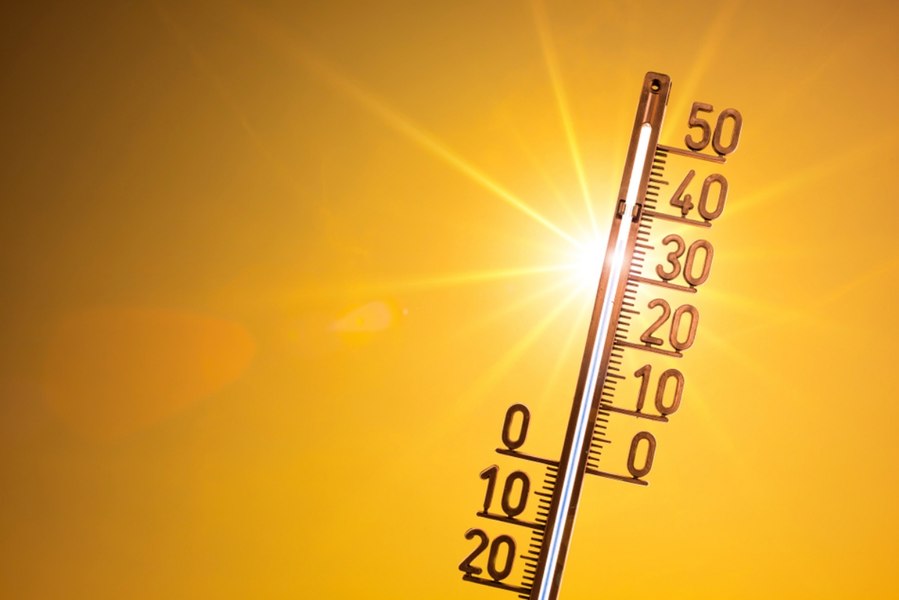
World's oceans hit record high in July amid Europe's hottest June-July period on record
Translated from Romanian, summarized and contextualized by DistantNews.
At a glance
News
Official statement
Context piece
- World's oceans reached their highest recorded temperature in July, with the average sea surface temperature outside polar regions setting a new record.
- Western Europe experienced its hottest June-July period on record, marked by repeated heatwaves, drought, and wildfires.
- Global average air temperature was 1.47 degrees Celsius above pre-industrial levels, with persistent high-pressure systems exacerbating heat and drought in Europe.
The world's oceans hit a record high temperature in July, marking the warmest July ever recorded for sea surface temperatures outside polar regions. This data comes from the Copernicus Climate Change Service, which also reported that Western Europe endured its hottest June-July period in history.
Europe faced repeated heatwaves, severe drought, and widespread wildfires. The average sea surface temperature between 60 degrees south and 60 degrees north latitude reached 20.96 degrees Celsius in July, surpassing the previous record of 20.89 degrees Celsius set in 2023. Record temperatures were particularly noted in the Atlantic and the western Mediterranean, where strong marine heatwaves developed. Conditions associated with El Niño also contributed to exceptionally high temperatures in much of the tropical Pacific.
Globally, July 2026 tied with July 2024 as the second-hottest July on record, trailing only July 2023. The planet's average air temperature was 16.90 degrees Celsius, a significant 1.47 degrees Celsius above the 1850-1900 pre-industrial estimate. In Western Europe, the average temperature for June and July reached 21.62 degrees Celsius, 2.79 degrees Celsius above the 1991-2020 average, exceeding the prior record from 2022. July itself was the second-hottest July in the region, with an average temperature of 22.48 degrees Celsius, 2.53 degrees Celsius above the reference period average.
Persistent high-pressure systems trapped warm air over Western Europe, intensifying the heat and drought. As soils dry out, their ability to cool the atmosphere naturally diminishes, allowing heat to build up further. This persistent heat has fueled drought conditions across France, Spain, parts of Germany, and the United Kingdom. The consequences have been visible in major European rivers like the Seine, Rhine, and Danube, which have reached exceptionally low levels, straining water supplies, agriculture, and irrigation.
This is a clear example of how climate change is intensifying extreme thermal events, with heat and drought feeding each other.
DistantNews Editorial
Originally published by Adevărul in Romanian. Translated, summarized, and contextualized by our editorial team with added local perspective. Read our editorial standards.
More Stories

From Our Blog

What Gets Lost (and Found) When News Is Translated

The Critical Role of Diaspora Media in Global News

What Travellers Should Know About Countries with Restricted Press

A Digital Nomad's Guide to Following Local News

How the Same Story Looks Different in Different Countries
