

Yucatán establishes red tide monitoring network to protect fishing activity
Translated from Spanish, summarized and contextualized by DistantNews.
At a glance
News
Sources not specified
Context piece
- Yucatán, Mexico, has established a monitoring network to combat red tide and protect its fishing industry.
- Communities in San Felipe and Río Lagartos received training to identify harmful algal blooms early.
- The initiative, a collaboration between state authorities, academia, and fishing cooperatives, aims to reduce economic and social impacts.
Fishermen and aquaculturists in eastern Yucatán are joining forces with state authorities and academics to create a red tide monitoring network. This initiative aims to prevent economic losses along the coast.
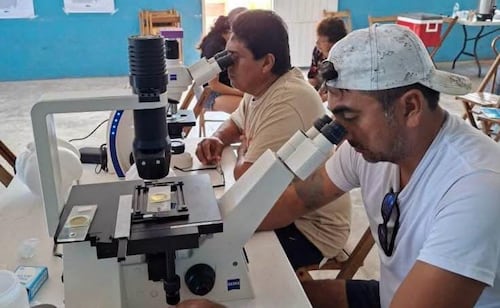
As part of this strategy, fishing communities in San Felipe and Río Lagartos received training to identify harmful algal blooms early.
Communities in San Felipe and Río Lagartos have already received training to identify harmful algal blooms, known as red tides, at an early stage. Lila Frías Castillo, head of the Secretariat of Sustainable Fisheries and Aquaculture of Yucatán (Sepasy), highlighted this training as part of the strategy.
The project is a joint effort involving the Center for Scientific Research of Yucatán (CICY), Environmental Defense Fund of Mexico (EDF México), Sepasy, and the Regional Federation of Fishing Cooperative Societies of the Eastern Zone of the State. CICY will provide scientific expertise on algal bloom behavior and monitoring mechanisms, while EDF México will focus on coordinating efforts between communities, authorities, and institutions to develop adaptation measures for climate change effects.
These data will be used to feed early warning systems that allow us to anticipate the presence of red tides and make decisions that reduce economic and social impacts.
Data gathered by fishing cooperatives and aquaculture units will feed early warning systems, enabling timely decisions to mitigate economic and social consequences. The network will also link with state and federal agencies responsible for health and environmental surveillance, and the newly formed Committee for Monitoring and Evaluating Harmful Algal Blooms in Yucatán to bolster prevention actions.
CICY will provide the scientific knowledge to understand the behavior of algal blooms and develop monitoring mechanisms, while EDF México will work on strengthening coordination between communities, authorities, and institutions to promote adaptation measures in the face of climate change effects.
DistantNews Editorial
Originally published by El Universal in Spanish. Translated, summarized, and contextualized by our editorial team with added local perspective. Read our editorial standards.
More Stories



From Our Blog

What Press Freedom Means for the News You Read

What Gets Lost (and Found) When News Is Translated

The Critical Role of Diaspora Media in Global News

What Travellers Should Know About Countries with Restricted Press

A Digital Nomad's Guide to Following Local News
