


8 of 90 EPN students to work on detector studying universe's origin
Translated from Spanish, summarized and contextualized by DistantNews.
At a glance
News
Sources not specified
Context piece
- Eight out of 90 students from Ecuador's National Polytechnic School (EPN) will work on the CMS experiment at CERN in Switzerland.
- These students will assemble and disassemble parts of the detector within the Large Hadron Collider, a feat unprecedented for Ecuadorians.
- This achievement highlights Ecuador's growing scientific capabilities, despite low national R&D investment, and is the result of a decade of collaboration between Ecuador and CERN.
Eight students from Ecuador's National Polytechnic School (EPN) have been selected to join the CMS experiment at CERN, the European Organization for Nuclear Research, in Switzerland. This marks a significant milestone as they become the first Ecuadorians to work technically within the Large Hadron Collider (LHC), the world's largest scientific infrastructure.
For me it was a sign that women can also develop and excel in technical areas like mechanical engineering.
Bryan Espinoza, Luis Viracocha, Andrea Gagnay, Pedro Tubay, Bryan Chariguamán, Esteban Córdova, Russell Catota, and Jordy Robles boarded a flight to Switzerland on June 29, 2026. Their role is not observational; they will be actively involved in assembling and disassembling components of the complex CMS detector. This opportunity arises from a decade-long, quiet collaboration between Ecuador and CERN, building trust through consistent research and responsible execution of commitments.
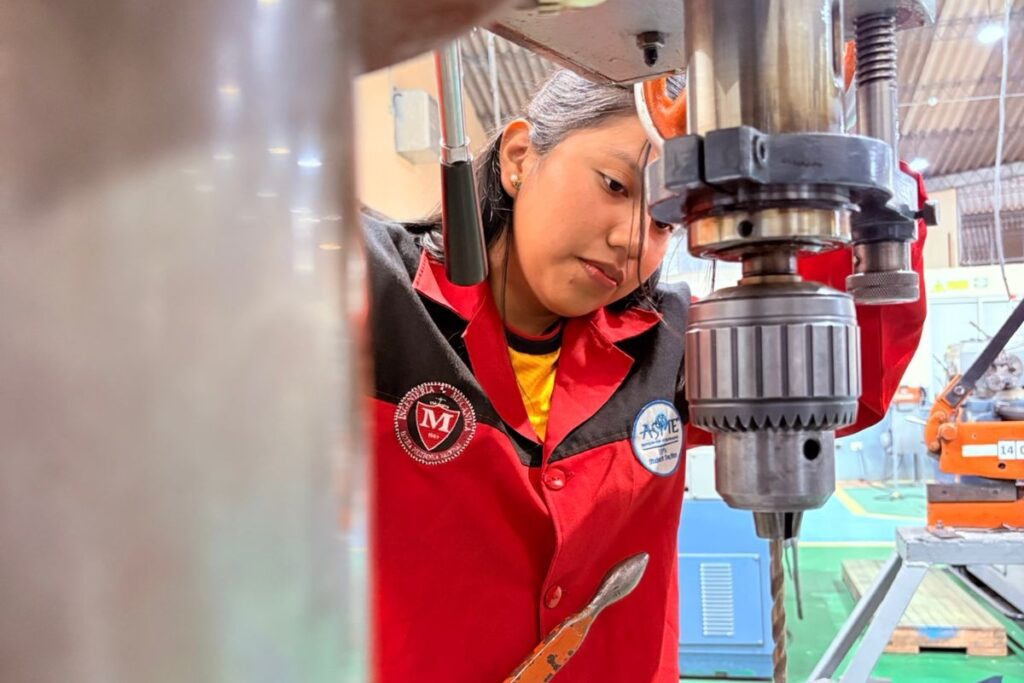
Andrea Gagnay, a 22-year-old mechanical engineering student, is the sole woman among the selected EPN students. Her selection was met with surprise and pride, serving as a powerful statement about women's capabilities in technical fields. She noted that initial perceptions of women facing difficulties with heavy equipment motivated her to excel, proving that capacity stems from effort and discipline, not gender.
Far from discouraging me, that motivated me to prepare better and demonstrate with results that capabilities do not depend on gender, but on effort, discipline, and constant learning.
This achievement is particularly noteworthy given Ecuador's low investment in research and development, which stands at 0.44% of its GDP, below the regional average. The successful selection of these eight technical students, not postgraduates or doctors, underscores the potential that can be realized through sustained institutional effort and international collaboration. The CMS experiment was instrumental in confirming the existence of the Higgs boson in 2012.
We started by earning the trust of CMS and CERN through research activities, fulfilling each commitment with responsibility and quality.
DistantNews Editorial
Originally published by El Comercio in Spanish. Translated, summarized, and contextualized by our editorial team with added local perspective. Read our editorial standards.
More Stories


From Our Blog

What Gets Lost (and Found) When News Is Translated

The Critical Role of Diaspora Media in Global News

What Travellers Should Know About Countries with Restricted Press

A Digital Nomad's Guide to Following Local News

How the Same Story Looks Different in Different Countries
