


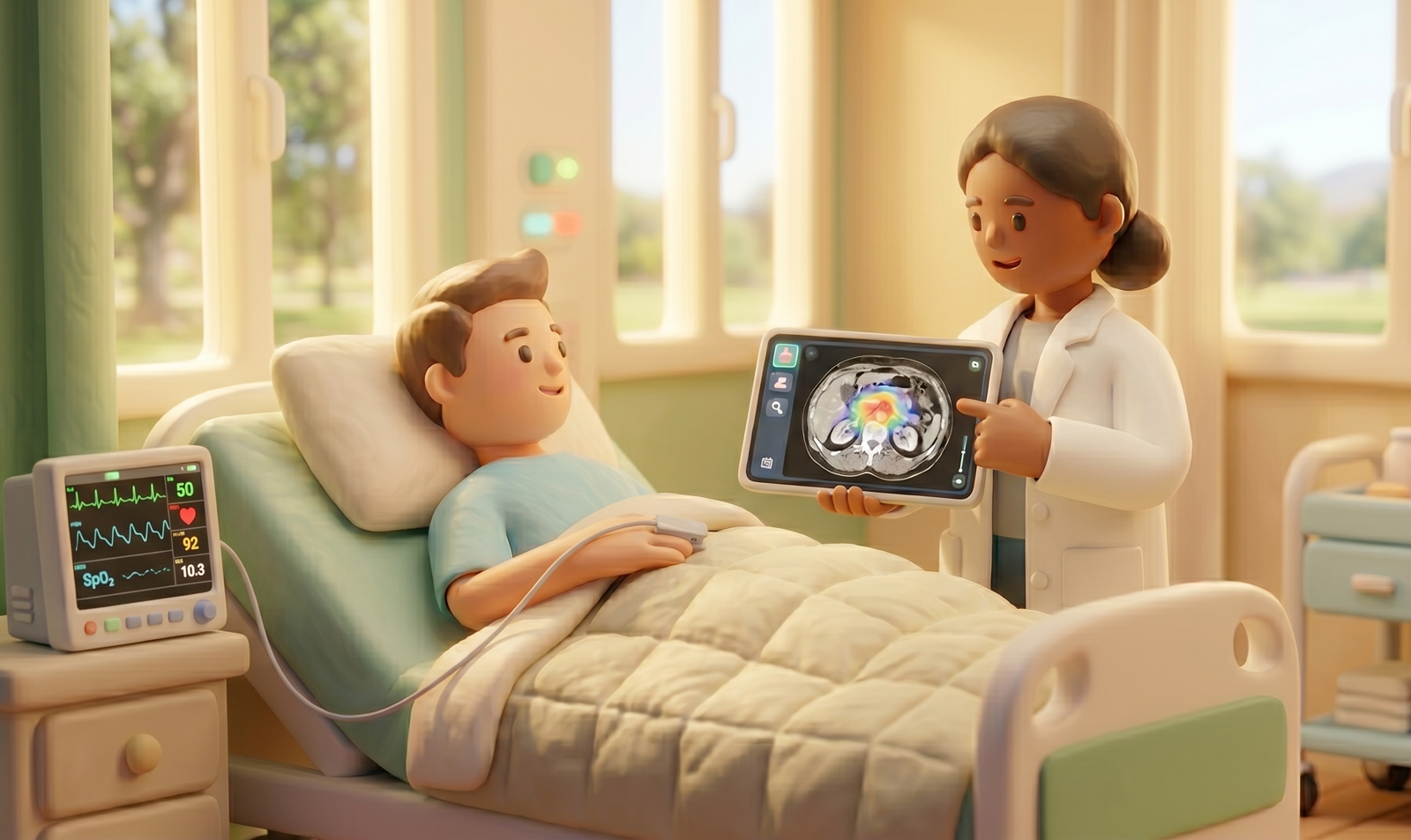
AI Detects Pancreatic Cancer Signs 3x More Accurately Than Doctors
Translated from Korean, summarized and contextualized by DistantNews.
TLDR
- A US research team developed an AI model that detects pancreatic cancer signs in CT scans with three times the accuracy of human specialists.
- The AI, named 'Redmod,' identifies subtle changes in scans, even those undetectable by the human eye, an average of 475 days before diagnosis.
- This advancement holds promise for improving early detection rates and survival for pancreatic cancer, which is notoriously difficult to diagnose early.
In a significant breakthrough for oncology, American researchers have developed an artificial intelligence model capable of detecting the early signs of pancreatic cancer in standard CT scans with remarkable accuracy—three times that of human specialists. This development, reported by Bloomberg, offers a glimmer of hope against one of the deadliest forms of cancer, where early detection is notoriously challenging.
The AI system, dubbed 'Redmod,' analyzes minute patterns within CT images that are often imperceptible to the human eye. In a comparative study, Redmod correctly identified early signs in 73% of cases, compared to the 39% accuracy rate of radiologists reviewing the same scans. Crucially, the AI could detect changes up to two years before diagnosis in some instances, with an average lead time of 475 days, significantly outperforming specialists who only identified such changes in 23% of cases over the same period.
Pancreatic cancer's grim prognosis, with a global 5-year survival rate around 10%, is largely due to its late-stage diagnosis. The AI's ability to spot subtle anomalies, even in scans initially deemed normal, could revolutionize screening protocols. Researchers suggest it could be particularly useful for high-risk individuals, such as those experiencing unexplained weight loss or newly diagnosed with diabetes. While further validation in real-world clinical settings is required, this AI represents a potential paradigm shift in the fight against pancreatic cancer, offering a vital tool to improve patient outcomes.
DistantNews Editorial
Originally published by Dong-A Ilbo in Korean. Translated, summarized, and contextualized by our editorial team with added local perspective. Read our editorial standards.
More Stories


From Our Blog

What Gets Lost (and Found) When News Is Translated

The Critical Role of Diaspora Media in Global News

What Travellers Should Know About Countries with Restricted Press

A Digital Nomad's Guide to Following Local News

How the Same Story Looks Different in Different Countries
