


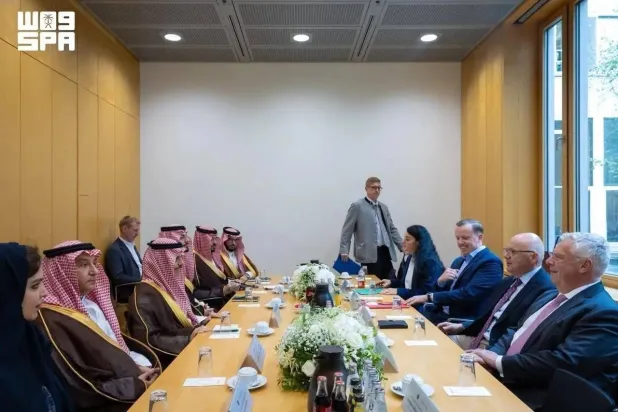

Alliances, energy security and balanced partnerships form pillars of Saudi stability
Translated from English and summarized by DistantNews. Read the original for the full story.
At a glance
News
Named sources
Context piece
- Experts at a Riyadh security conference identified alliances, energy security and independent decision-making as pillars of Saudi Arabia’s stability.
- Abdulrahman Al-Rashed said regional alliances could deter attacks, citing Saudi Arabia’s military ties with Pakistan and growing cooperation with Türkiye.
- Energy adviser Ibrahim Al-Muhanna said domestic security supports Saudi oil exports, while the East-West pipeline provides an alternative route from the Gulf to the Red Sea.
Saudi Arabia’s stability depends on more than military alliances, according to experts speaking at the Security and History Dialogue 2026 Conference in Riyadh. They linked security, reliable energy supplies and independent decision-making as mutually reinforcing pillars, while arguing that balanced partnerships can preserve international ties without compromising sovereignty.
Saudi journalist and Asharq Al-Awsat columnist Abdulrahman Al-Rashed said major alliances were needed to prevent war. He pointed to the Gulf Cooperation Council as a bloc created to confront Iranian threats, followed by other coalitions, including the alliance that liberated Kuwait, in which the GCC took part.
Al-Rashed said Saudi Arabia had faced attacks from three directions, directly from Iran and also from Iraq and Yemen. He described Saudi Arabia’s alliance with Pakistan and Türkiye as a grouping of countries bordering Iran, but said its purpose extended beyond Tehran and focused more broadly on protecting states from attack. He cited Saudi-Pakistani military ties dating to the 1970s and 1990s, along with expanding Saudi-Turkish military cooperation over the past three or four years. Türkiye’s defense industry, he said, strengthened the deterrent message.
Energy adviser Ibrahim Al-Muhanna said domestic and international energy security were essential to economic growth, internal stability and citizens’ well-being. Saudi Arabia is the world’s second-largest oil producer and exporter, he said, and is virtually alone in maintaining spare production capacity that can compensate for supply shortages elsewhere.
Al-Muhanna said protecting oil facilities had been a priority since the reign of King Abdulaziz. Recalling the tanker war of the 1980s, he said Saudi Arabia began planning ways to move oil from the Gulf to the Red Sea, leading to the East-West pipeline. The pipeline now carries about 7 million barrels and supplies Red Sea refineries, while offering an alternative when Gulf exports face disruption.
About this summary
Originally published by Asharq Al-Awsat in English. Translated, summarized, and contextualized automatically by DistantNews, with a note on how the source frames the story. Not individually reviewed before publishing. How this works.
More Stories


From Our Blog

News in Translation: What Gets Lost, and How We Keep the Framing

Diaspora Media: How Communities Follow News From Home

Traveling Where the Press Is Not Free: How to Read the News There

The Digital Nomad's Guide to Local News

The Same Story, Different Countries: How Coverage Changes at the Border
