

Ancient Skeletons Found in Seated Position Beneath French Schoolyard
Translated from Greek, summarized and contextualized by DistantNews.
TLDR
- Archaeologists in Dijon, France, discovered dozens of ancient skeletons buried in an unusual seated position beneath a schoolyard.
- The findings, announced by France's National Institute for Preventive Archaeological Research (Inrap), build upon previous discoveries at the site from 2024.
- The skeletons, dating back to at least the 3rd century BC, show signs of violent trauma, suggesting possible ritualistic killings or executions.
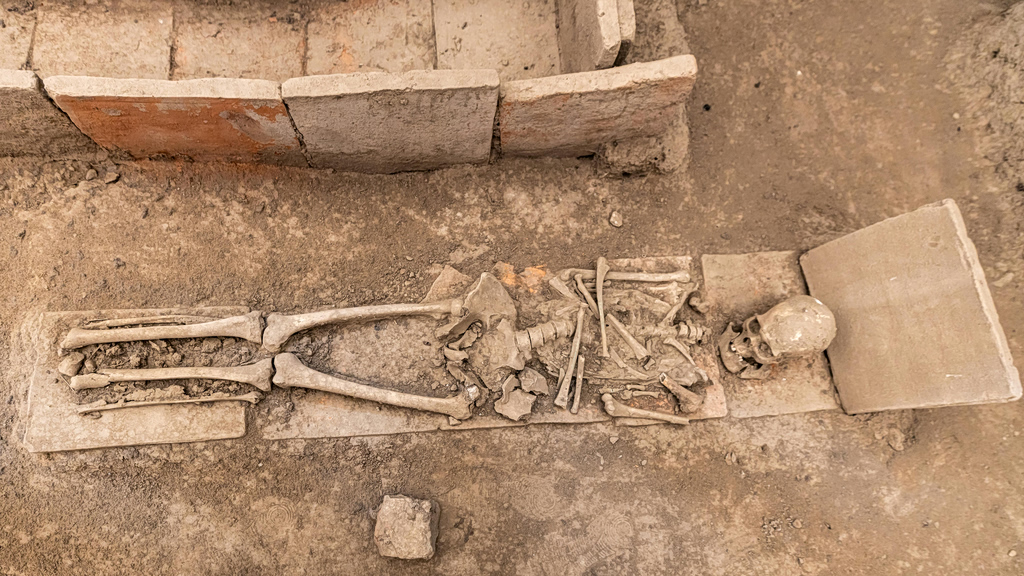
A chilling discovery has been made beneath the grounds of the Josephine Baker school complex in Dijon, France, where archaeologists have unearthed dozens of ancient skeletons. These remains, found buried in a peculiar seated posture, have sent ripples of intrigue through the scientific community. The National Institute for Preventive Archaeological Research (Inrap) announced the findings in March, adding to previous discoveries made at the same location in 2024.
καθιστή στάση
The recent excavation revealed five to six new graves, distinct from the 13 found previously. These newly discovered individuals were found seated at the bottom of pits, their backs against the eastern wall, facing west. Their arms rested along their torsos, with legs sharply bent, often asymmetrically. This unusual burial practice, while known from the Mesolithic era, is rare and typically associated with elite residences, sanctuaries, or places of worship, rather than conventional cemeteries.
καθισμένοι στο κάτω μέρος του λάκκου, με την πλάτη προς τον ανατολικό τοίχο και στραμμένοι προς τη δύση
Adding a layer of mystery and grim fascination, the skeletons bear marks of unhealed violence. Inrap noted that these injuries "likely indicate intentional killing" and included cuts on upper arm bones, with one individual showing signs of two blows from a sharp object, possibly a sword, to the skull. The absence of personal belongings or grave goods, apart from a black stone armband dating to the 3rd century BC, further deepens the enigma surrounding these ancient burials. The discovery is considered significant due to the number of remains and their remarkable state of preservation, offering a rare glimpse into potentially violent aspects of prehistoric life in the region.
Τα χέρια τους ακουμπούν κατά μήκος του κορμού, με τις παλάμες κοντά στη λεκάνη ή στους μηρούς
DistantNews Editorial
Originally published by Ta Nea in Greek. Translated, summarized, and contextualized by our editorial team with added local perspective. Read our editorial standards.
More Stories


From Our Blog

What Gets Lost (and Found) When News Is Translated

The Critical Role of Diaspora Media in Global News

What Travellers Should Know About Countries with Restricted Press

A Digital Nomad's Guide to Following Local News

How the Same Story Looks Different in Different Countries
