


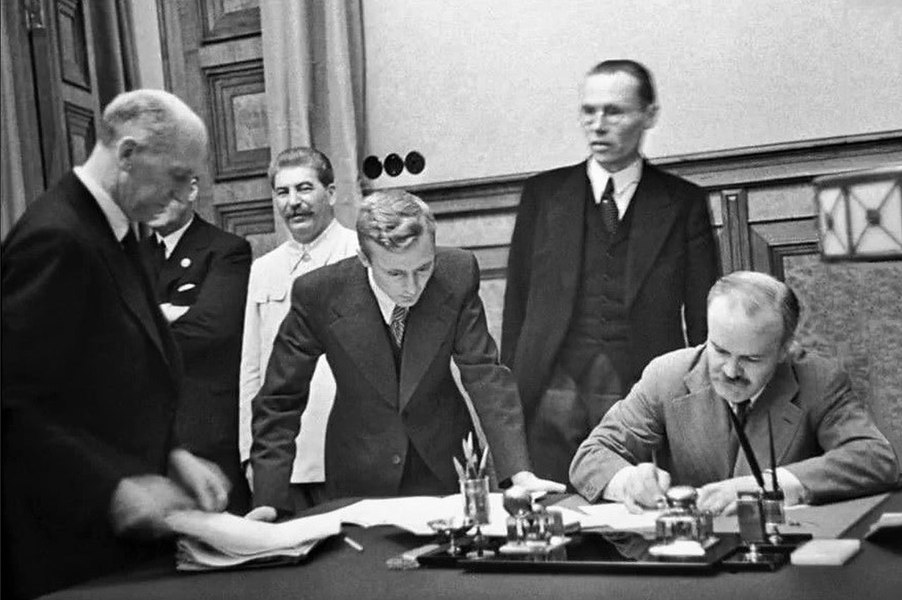
August 23: The Day the Ribbentrop-Molotov Pact, an Alliance Against Democracy, Was Signed
Translated from Romanian, summarized and contextualized by DistantNews.
At a glance
News
Sources not specified
Context piece
- On August 23, 1939, Nazi Germany and the Soviet Union signed the Ribbentrop-Molotov Pact, a non-aggression treaty with a secret protocol to divide Eastern and Central Europe.
- The pact surprised Western governments and paved the way for Germany and the Soviet Union to invade Poland, initiating World War II.
- The treaty had devastating consequences for countries in the region, including Romania, which had previously maintained good relations with Britain and France but poor relations with Germany and the Soviet Union.
On August 23, 1939, a geopolitical surprise unfolded as Nazi Germany and the Soviet Union signed the Ribbentrop-Molotov Pact. This non-aggression treaty included a secret protocol that divided Eastern and Central Europe between the two totalitarian powers.
The signing of the Ribbentrop-Molotov Pact, an alliance against democracy.
The pact, named after the foreign ministers Joachim von Ribbentrop and Vyacheslav Molotov, caught Western governments completely off guard. It set the stage for the joint invasion of Poland by Germany and the Soviet Union, directly triggering the outbreak of World War II.
The non-aggression pact between Nazi Germany and the Soviet Union, signed on August 23, 1939, represents perhaps the biggest geopolitical 'surprise' in modern history.
The consequences of this pact were dire for the nations within the affected regions. Romania, in particular, found itself in a precarious position. At the end of 1939, Romania was one of the few Eastern European states with a partially democratic regime. However, its political system was under pressure from King Carol II, who sought to establish an authoritarian rule. Externally, Romania enjoyed strong ties with Great Britain and France, but faced severe hostility from both Nazi Germany and the Soviet Union. A visible animosity existed between King Carol II and Adolf Hitler, evident during their meeting in July 1940.
Two totalitarian regimes, whose existence was justified by the defeat of the other, were shaking hands over a Europe for which the news fell like a 'hammer blow,' as Carol II would note in his diary in June 1940, when the Soviets claimed Bessarabia.
DistantNews Editorial
Originally published by Adevărul in Romanian. Translated, summarized, and contextualized by our editorial team with added local perspective. Read our editorial standards.
More Stories



From Our Blog

What Gets Lost (and Found) When News Is Translated

The Critical Role of Diaspora Media in Global News

What Travellers Should Know About Countries with Restricted Press

A Digital Nomad's Guide to Following Local News

How the Same Story Looks Different in Different Countries
