


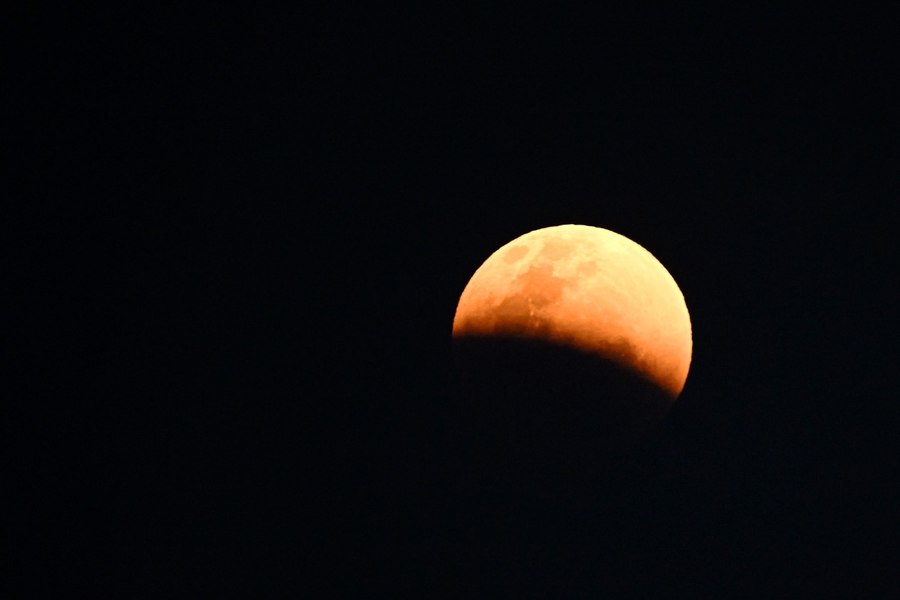
August's Sturgeon Moon to feature spectacular partial lunar eclipse
Translated from Romanian and summarized by DistantNews. Read the original for the full story.
At a glance
News
Sources not specified
Outcome reported
- The August 2026 full moon, traditionally called the Sturgeon Moon, will coincide with a partial lunar eclipse on the night of August 27-28.
- The eclipse will be visible from Europe, including Romania, though the most spectacular part will occur near moonset for viewers in Romania.
- The phenomenon occurs when the Earth passes between the Sun and the Moon, casting a shadow on the lunar surface, and this year's eclipse is notable for its depth, with about 93% of the Moon's diameter expected to be in Earth's umbra.
The August 2026 full moon, known traditionally as the Sturgeon Moon, promises a remarkable celestial display on the night of August 27-28. This year, the full moon coincides with a partial lunar eclipse, offering skygazers a chance to witness the Earth's shadow gradually obscuring a significant portion of the lunar disk.
The eclipse will be observable across Europe, including Romania. However, for those in Romania, the most dramatic phase of the eclipse will occur close to the time the moon sets, according to NASA. Globally, the eclipse's maximum phase is expected around 4:13 UTC, when approximately 93% of the Moon's diameter will be engulfed by Earth's central shadow. While the Moon won't be entirely hidden, the shadowed portion may take on reddish or coppery hues.
The name 'Sturgeon Moon' originates from North American traditions, particularly from agricultural calendars, referencing the abundance of sturgeon fish caught during this time of year in northern waters. In Romania, this designation is largely adopted from international popular astronomy culture rather than being a deeply rooted local tradition.
A full moon occurs when the Earth is positioned directly between the Sun and the Moon, causing the lunar hemisphere facing Earth to be almost fully illuminated. The overlap of the full moon phase with this partial eclipse makes the event particularly intriguing. Instead of a uniformly bright disk, observers will see the Earth's shadow creeping across the lunar surface.
For viewers in Romania, a key detail is that the eclipse will not be fully visible. As the phenomenon unfolds, the Moon will descend towards the horizon, setting before the eclipse reaches its astronomical peak. In Bucharest, for instance, Earth's penumbra will begin to touch the lunar disk around 4:23 AM, with the partial phase commencing at approximately 5:33 AM. The Moon will be very low on the horizon near its local maximum around 6:33 AM.
About this summary
Originally published by Adevărul in Romanian. Translated, summarized, and contextualized automatically by DistantNews, with a note on how the source frames the story. Not individually reviewed before publishing. How this works.
More Stories


From Our Blog

What Gets Lost (and Found) When News Is Translated

The Critical Role of Diaspora Media in Global News

What Travellers Should Know About Countries with Restricted Press

A Digital Nomad's Guide to Following Local News

How the Same Story Looks Different in Different Countries
