


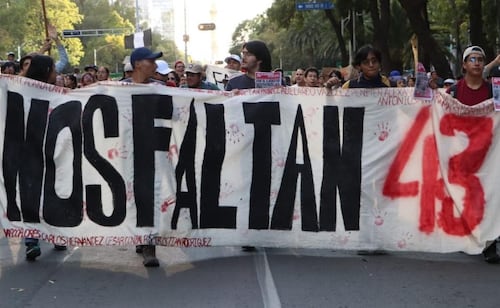
Ayotzinapa Case: Expert Warns Aguirre's Arrest Won't Solve Disappearances Crisis, Calls for Institutional Strengthening
Translated from Spanish, summarized and contextualized by DistantNews.
At a glance
News
Named sources
Context piece
- The arrest of former Guerrero Governor Ángel Aguirre Rivero for his alleged role in the disappearance of 43 students revives the debate on one of Mexico's most emblematic forced disappearance cases.
- An expert warns that while judicial actions are increasing, they do not address the state's structural limitations in investigating disappearances, identifying victims, and punishing those responsible.
- The Ayotzinapa case highlights Mexico's institutional shortcomings in handling forced disappearances and the ongoing struggle of families for truth and justice.
The arrest of former Guerrero Governor Ángel Aguirre Rivero, implicated in the 2014 disappearance of 43 students from the Ayotzinapa Rural Teachers' College, has reignited debate over one of Mexico's most notorious forced disappearance cases. However, experts argue that new judicial actions do not resolve the deep-seated institutional failures that hinder truth and justice.
Beyond new judicial actions, the Ayotzinapa case continues to highlight the institutional limitations for investigating disappearances, identifying victims, and sanctioning those responsible.
Salvador Guerrero, director of the Refugee Clinic at Universidad Iberoamericana, stated that the Ayotzinapa case has become a national and international symbol of the Mexican state's deficiencies in addressing forced disappearances. He noted that authorities at various levels participated, either through action or omission.
The disappearance of the 43 students in Iguala, Guerrero, on September 26-27, 2014, drew international scrutiny to Mexican institutions. Subsequent investigations questioned the "historic truth" presented during the Enrique Peña Nieto administration, uncovering alleged omissions, cover-ups, and potential responsibilities of public officials and criminal groups.
Ayotzinapa transcended being a criminal investigation and became a national and international benchmark due to the Mexican state's deficiencies in addressing forced disappearances, as well as the participation, by action or omission, of authorities at various levels.
Despite nearly 12 years passing, Guerrero warned that judicial progress remains insufficient without addressing the structural flaws that allow such crimes to persist. He identified three key areas needing state strengthening: professionalizing investigative institutions, enhancing and ensuring the independence of forensic services, and improving technical and operational capabilities. Many forensic units currently depend administratively on prosecutors' offices, lack adequate resources, and face heavy workloads.
Judicial progress is not enough if the structural flaws that allow these crimes to continue are not addressed.
DistantNews Editorial
Originally published by El Universal in Spanish. Translated, summarized, and contextualized by our editorial team with added local perspective. Read our editorial standards.
More Stories

From Our Blog

What Press Freedom Means for the News You Read

What Gets Lost (and Found) When News Is Translated

The Critical Role of Diaspora Media in Global News

What Travellers Should Know About Countries with Restricted Press

A Digital Nomad's Guide to Following Local News
