


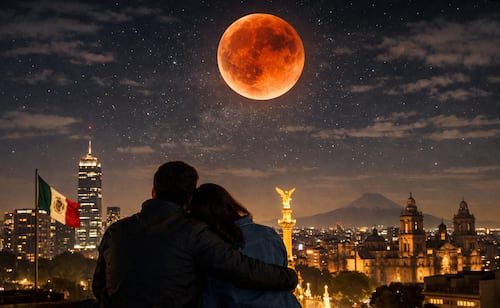
Blood Moon: When to see the astronomical phenomenon in August and how to enjoy the lunar eclipse
Translated from Spanish, summarized and contextualized by DistantNews.
At a glance
News
Sources not specified
Context piece
- A partial lunar eclipse, known as a Blood Moon, will be visible across the Americas on August 27-28, 2026.
- Approximately 93.9% of the moon will be covered by Earth's shadow, giving it a reddish hue due to atmospheric light scattering.
- The event is best viewed from areas with low light pollution and clear horizons, with binoculars or telescopes enhancing the experience.
Millions will turn their eyes to the sky in August 2026 for a partial lunar eclipse, dubbed a "Blood Moon." The event promises to be one of the year's most striking celestial displays, visible across much of the Americas, including Mexico.
While only a portion of the moon will enter Earth's darkest shadow, the umbra, the eclipse will be particularly deep. An estimated 93.9% of the lunar disk will be obscured by Earth's shadow. This significant coverage will enhance the appearance of reddish tones across much of the moon's surface.
The characteristic red color is not an intrinsic change in the moon itself. Instead, it's a phenomenon caused by Earth's atmosphere filtering and bending sunlight. Blue wavelengths scatter more easily, allowing red light to pass through and illuminate the lunar surface – the same physical process that colors sunrises and sunsets.
Mexico will have a prime view of the partial lunar eclipse, provided weather conditions permit a clear sky on the night of August 27. All regions of the country, from major cities like Mexico City and Guadalajara to border towns like Tijuana, will be able to witness the spectacle. The exact timing of each phase will vary slightly due to time zones, and cloud cover could pose a challenge for observers.
To best enjoy the celestial show, experts recommend finding a location with minimal light pollution and a clear view of the horizon. While not essential, binoculars or a telescope can offer a more detailed view of the lunar surface's changing appearance. Checking the weather forecast beforehand is also advised. Although the red hue may be visible, it is expected to be less intense than during a total lunar eclipse when the moon is fully immersed in Earth's shadow.
DistantNews Editorial
Originally published by El Universal in Spanish. Translated, summarized, and contextualized by our editorial team with added local perspective. Read our editorial standards.
More Stories



From Our Blog

What Press Freedom Means for the News You Read

What Gets Lost (and Found) When News Is Translated

The Critical Role of Diaspora Media in Global News

What Travellers Should Know About Countries with Restricted Press

A Digital Nomad's Guide to Following Local News
