


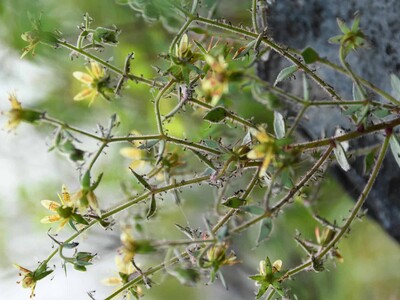
Carnivorous plant confirms Darwin's theory
Translated from Spanish, summarized and contextualized by DistantNews.
At a glance
News
Sources not specified
Context piece
- Scientists have confirmed that the alpine plant Saxifraga candelabrum is carnivorous, supporting a 150-year-old theory by Charles Darwin.
- The plant attracts, traps, and digests insects, absorbing nitrogen from them, as demonstrated by a study in Nature Communications.
- This discovery suggests that carnivory might be more widespread among flowering plants than previously believed.
A small alpine plant with delicate white and yellow flowers, the Saxifraga candelabrum, has been confirmed as carnivorous, validating a hypothesis put forth by Charles Darwin over 150 years ago. A new study published in Nature Communications reveals that this plant belongs to a previously unrecognized carnivorous lineage, capable of luring, capturing, and digesting insects to absorb vital nitrogen.
While many plants exhibit traits for capturing prey, formal classification as carnivorous requires adaptations for attraction, trapping, digestion, and nutrient absorption. Darwin speculated in 1875 that some Saxifraga species might be carnivorous due to sticky glandular hairs on their stems that trap insects, but conclusive evidence was lacking until now.
A research team, led by the Chinese Academy of Sciences, investigated S. candelabrum specimens from the Qinghai-Tibet Plateau and Hengduan Mountains. Field observations and sample analyses showed insects trapped on the glandular hairs of most studied plants, with mature specimens averaging 71 trapped insects. The presence of phosphatase, a digestive enzyme common in carnivorous plants, suggests S. candelabrum can digest its prey.
Further experiments involved feeding the plants marked Drosophila flies to test nutrient absorption. The study observed a significant increase in marked nitrogen levels in S. candelabrum and a control carnivorous species, unlike non-carnivorous controls. Genetic analysis also revealed similarities with other independently evolved carnivorous plants, including genes related to prey attraction, digestion, and nutrient uptake. The findings provide definitive proof of carnivory in Saxifraga, answering Darwin's long-standing hypothesis and indicating that this trait may be more prevalent among angiosperms than previously thought.
DistantNews Editorial
Originally published by Diario Libre in Spanish. Translated, summarized, and contextualized by our editorial team with added local perspective. Read our editorial standards.
More Stories



From Our Blog

What Gets Lost (and Found) When News Is Translated

The Critical Role of Diaspora Media in Global News

What Travellers Should Know About Countries with Restricted Press

A Digital Nomad's Guide to Following Local News

How the Same Story Looks Different in Different Countries
