


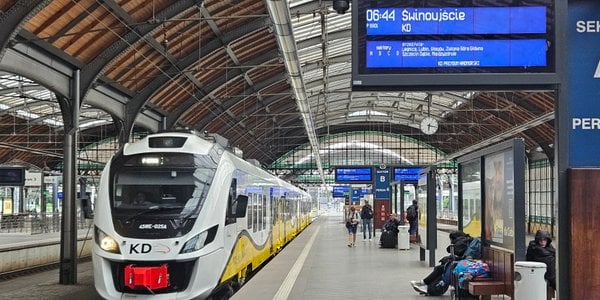
Carriers Turn to Leased Trains as EU Funding Favors Advanced Projects
Translated from Polish and summarized by DistantNews. Read the original for the full story.
At a glance
Analysis
Named sources
Approved/passed
- Poland’s Centre for EU Transport Projects allocated 1.4613 billion złoty for zero-emission passenger rail rolling stock.
- PKP Intercity, Silesia, the Upper Silesian-Zagłębie Metropolis, Małopolskie Railways and Lower Silesian Railways received funding.
- Expert Marcel Klinowski criticized the funding model for favoring financially stronger applicants and widening regional differences in rail services.
Poland has distributed 1.4613 billion złoty for zero-emission passenger trains, but the funding decision has renewed criticism that the system rewards operators already able to finance major purchases.
PKP Intercity received 512.3 million złoty. The Silesian regional government received 326 million, the Upper Silesian-Zagłębie Metropolis 321.5 million, Małopolskie Railways 152.4 million and Lower Silesian Railways 149.2 million.
In line with the long-standing practice of spending EU funds, the projects assessed most highly in this call were also those most advanced in implementation.
Market expert Marcel Klinowski said the main list included projects already far advanced, including investments where deliveries had begun. That approach, he argued, provides confidence that the projects can be settled by the end of 2029, but it also directs public money first to beneficiaries with the strongest finances. Such recipients can carry out investments through commercial financing before securing additional EU support.
This mechanism means that public funds first go to beneficiaries in the strongest financial position, who can carry out these investments through commercial financing and then obtain additional benefits through EU funding.
Klinowski warned that this policy could deepen differences in rolling-stock quantity, quality and service offers. Long-distance services accounted for more than 20% of passenger journeys in 2025, he said, and some regions with below-average services now have as many long-distance trains as regional ones, or more.
He said Polregio had much less chance in this funding round because it runs relatively few metropolitan services, while regions often acquire trains directly and then make them available to operators. Polregio plans instead to obtain 15 hybrid units through a loan from the Security and Defence Fund. The trains could carry passengers in normal use and be quickly adapted to transport injured people on stretchers with medical equipment. Polregio president Andrzej Pawłowski said the company is the only passenger carrier in Poland able to organize such rapid transport and has demonstrated that capability before.
Polregio, as the only passenger carrier in the country, is able to organize such rapid transport, as we have already demonstrated.
About this summary
Originally published by Rzeczpospolita in Polish. Translated, summarized, and contextualized automatically by DistantNews, with a note on how the source frames the story. Not individually reviewed before publishing. How this works.
More Stories



From Our Blog

What Gets Lost (and Found) When News Is Translated

The Critical Role of Diaspora Media in Global News

What Travellers Should Know About Countries with Restricted Press

A Digital Nomad's Guide to Following Local News

How the Same Story Looks Different in Different Countries
