

Central and Eastern Europe Needs New Investment Drive to Close 1 Trillion Euro Gap
Translated from Polish, summarized and contextualized by DistantNews.
At a glance
Analysis
Sources not specified
Context piece
- Central and Eastern Europe faces a long-term investment gap of approximately 1 trillion euros, according to the Bank Gospodarstwa Krajowego (BGK).
- Closing this gap requires increased investment and stronger local capital markets, with a greater role for private capital.
- Challenges include access to capital, security, defense, and technological sovereignty, all of which depend on capital investment.
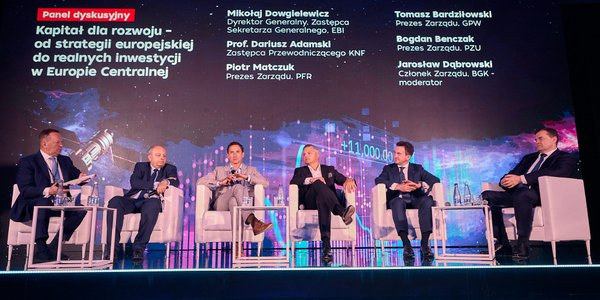
Central and Eastern Europe requires a significant new investment impulse to address a long-term funding gap estimated at around 1 trillion euros, according to the Bank Gospodarstwa Krajowego (BGK).
While the region has made strides in closing the economic distance with Western Europe over the past two decades, further convergence hinges on substantially increasing investment and cultivating more robust local capital markets. BGK President Mirosław Czekaj emphasized that Europe needs capital and greater competitiveness to meet contemporary challenges. He identified three strategic priorities for the region: ensuring access to capital, enhancing security and defense capabilities, and building technological sovereignty – all of which are contingent upon capital investment.
A report presented by BGK highlights that despite dynamic growth, the region remains underinvested. Labor productivity averages about 72% of the EU norm, road infrastructure lags behind Western Europe in many countries, and the energy transition demands billions in funding. Annual investment needs for infrastructure alone are estimated at 65-75 billion euros, with an additional 50 billion euros required for maintenance. This cumulative need points to a 1 trillion euro investment gap that could take two decades to close.
The traditional development financing model, heavily reliant on EU funds and public debt, is approaching its limits. Consequently, private capital must play an increasingly vital role. A key obstacle is the underdeveloped capital market. Stock market capitalization in Central and Eastern European countries represents about 17% of GDP, compared to over 40% in Germany and around 170% in Sweden. Pension fund assets are also considerably smaller, accounting for roughly 10% of GDP in the region versus over 200% in Denmark. This limits the financing available for innovative companies and the development of the private equity market.
DistantNews Editorial
Originally published by Rzeczpospolita in Polish. Translated, summarized, and contextualized by our editorial team with added local perspective. Read our editorial standards.
More Stories

From Our Blog

What Gets Lost (and Found) When News Is Translated

The Critical Role of Diaspora Media in Global News

What Travellers Should Know About Countries with Restricted Press

A Digital Nomad's Guide to Following Local News

How the Same Story Looks Different in Different Countries
