


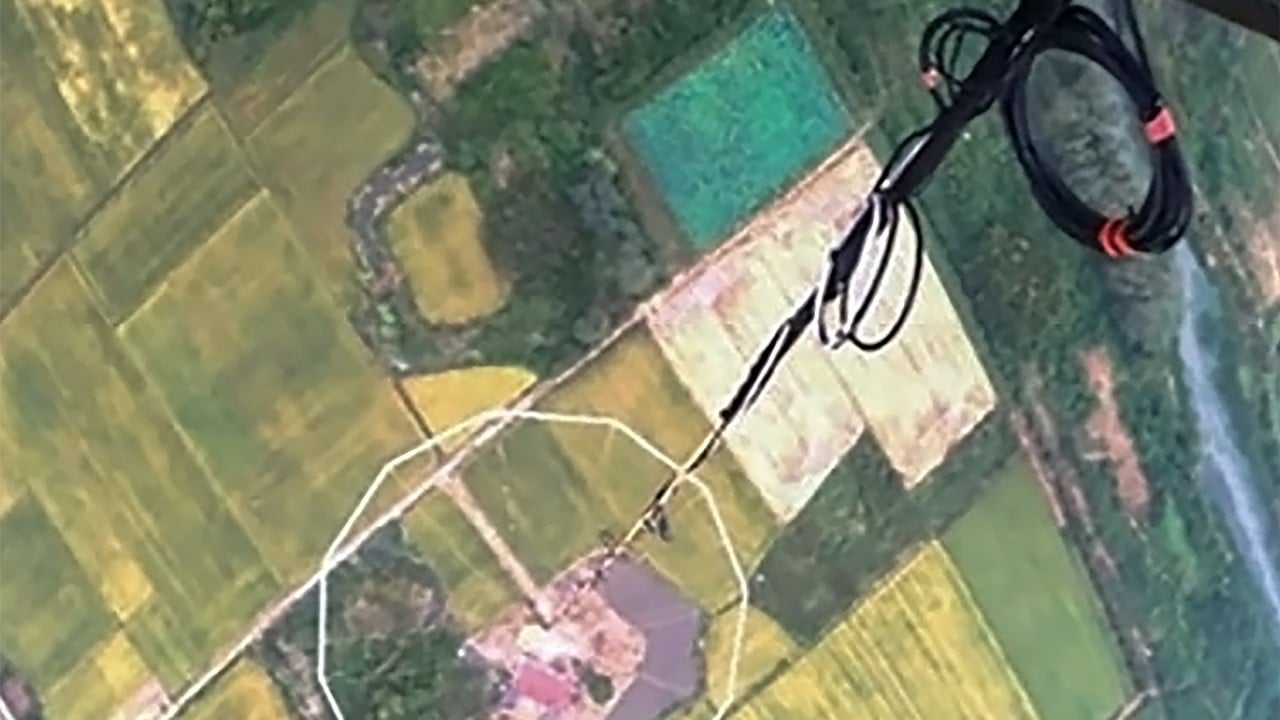
China conducts test flight of a giant coil array. Can it detect nuclear submarines?
Summarized and contextualized by DistantNews.
At a glance
News
Documents & data
New plan
- China has successfully conducted a test flight of a large coil array system towed by a helicopter.
- The Airborne Transient Electromagnetic (Atem) detection system uses powerful electromagnetic pulses to detect conductive materials underground or underwater.
- Researchers aim to use this technology to identify potential targets like nuclear submarines, solving engineering challenges for airborne geophysical surveys.
China has successfully tested a novel airborne electromagnetic detection system, potentially capable of locating nuclear submarines. The system, called Airborne Transient Electromagnetic (Atem) detection, involves a helicopter towing a large coil array. It works by emitting a powerful electromagnetic pulse that penetrates the ground or water, inducing eddy currents in conductive materials. A receiver coil then detects the secondary magnetic field generated by these currents, allowing scientists to analyze the object's presence, depth, and composition. The results of this test flight were published in the Chinese journal Acta Aeronautica et Astronautica Sinica. Associate professor Fu Jingcheng of Beihang University and the Chinese Academy of Sciences' Institute of Geology and Geophysics led the research, overcoming significant engineering hurdles to stabilize the complex multi-coil system during flight for geophysical surveys.
DistantNews Editorial
Originally published by South China Morning Post. Summarized and contextualized by our editorial team with added local perspective. Read our editorial standards.
More Stories


From Our Blog

Countries Without a Free Press: What You Need to Know

What Press Freedom Means for the News You Read

What Gets Lost (and Found) When News Is Translated

The Critical Role of Diaspora Media in Global News

What Travellers Should Know About Countries with Restricted Press
